SEO for roofers is shifting as AI-powered search engines and voice search become dominant. By 2026, traditional search volumes are expected to drop 25%, with AI influencing $750 billion in revenue by 2028. Local SEO remains critical, as 60–90% of leads come from the Map Pack, and over 70% of roofing leads come from mobile devices. Despite this, 95% of local contractors have fewer than five blog posts, presenting a huge opportunity to stand out.
Key strategies include:
To succeed, focus on building trust with AI, leveraging local SEO, and ensuring technical excellence. Roofers who adapt to these trends will see more leads and conversions.
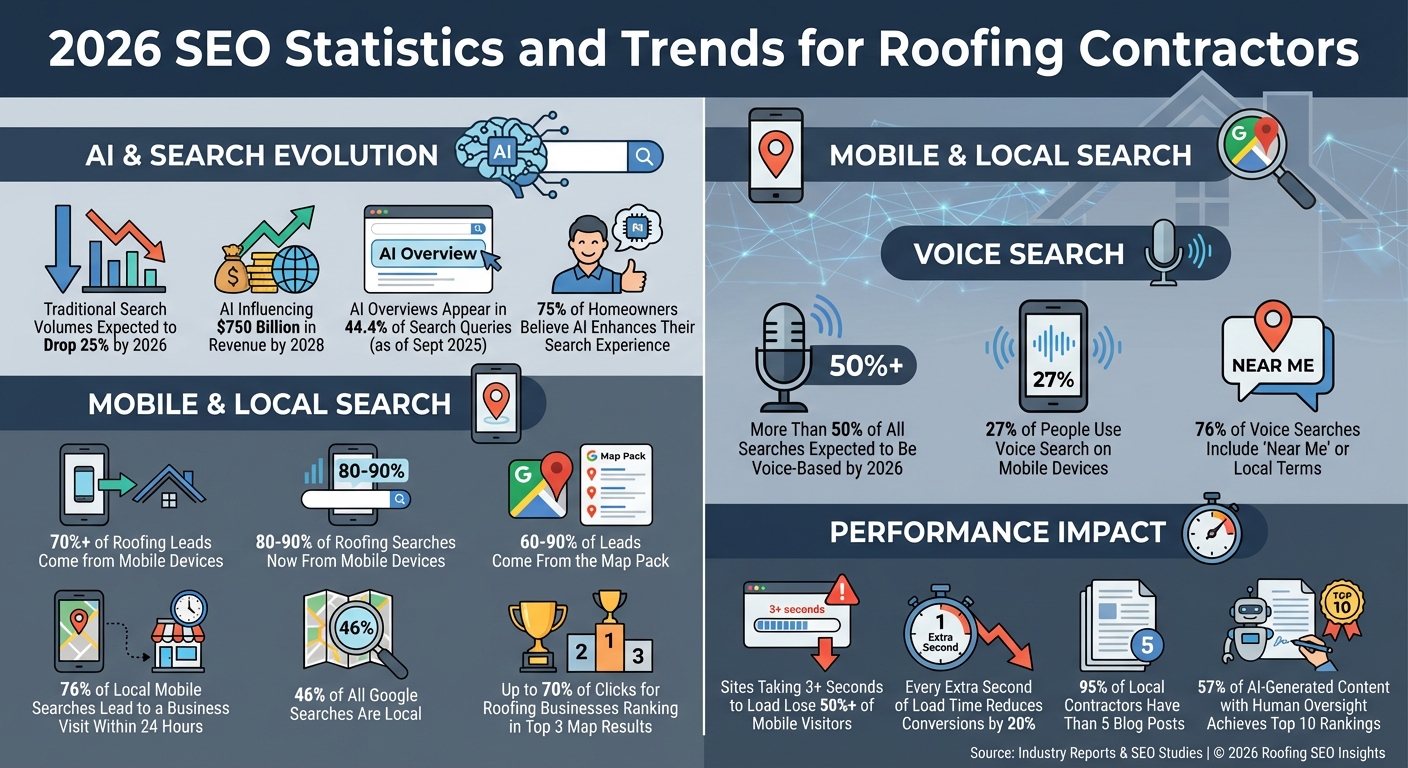
2026 SEO Statistics and Trends for Roofing Contractors
AI tools have completely redefined keyword research, processing over 40,000 data points per keyword to replace tedious manual spreadsheet work with an efficient, insight-driven method. By leveraging Natural Language Processing (NLP), these tools can grasp context, sentiment, and the relationships between words and concepts. This shift has revolutionized how businesses discover and target keywords, setting the stage for more precise strategies.
Modern platforms like Moz Keyword Explorer and Semrush Keyword Overview offer "AI-Powered Insights" that help identify the "Primary Search Intent" behind each keyword. This means you can better understand whether a query like "roof repair" reflects a DIY approach or someone looking to hire a contractor.
AI’s ability to process complex, conversational queries ensures it aligns with real customer needs. For example, when someone searches, "What’s the best roofing material for a lakefront home in Muskoka that can handle heavy snow?" AI tools such as ChatGPT, Perplexity, and Google’s AI Overview can pinpoint the specific service and regional requirements. This enables the creation of a "Target Query Map" that prioritizes high-value commercial and informational queries tailored to your business and location.
"AI search tools now use vector embeddings that understand meaning, not just keywords. Roofers who structure content around ideas – not just phrases – will dominate AI-powered discovery. Focus on clarity, trust, and unique data." – Adam Sand, Author, roofingbusinesspartner.com
To maximize results, feed AI tools with comprehensive data like your website’s content inventory, audit findings, and business constraints such as budget and seasonality. This approach helps generate keyword strategies that focus on high-intent local keywords like "roof repair near me", "emergency roof leak [city]", and "storm damage roofing company." Adding modifiers like "affordable", "licensed", and "insurance approved" can further refine your targeting.
AI doesn’t just stop at keyword insights – it also simplifies content planning. With the ability to generate thousands of relevant keywords, questions, and long-tail variations from a single seed topic in seconds, AI can produce blog drafts, ad copy, or homeowner guides in minutes.
For roofing businesses, this means you can quickly develop seasonal content tied to local weather patterns. For instance, AI can help generate ideas like "How to prevent ice dams in Alberta" or create email campaigns targeting specific service areas. AI-powered tools also analyze Search Engine Results Pages (SERPs) to cluster keywords with overlapping results, helping you decide which topics to combine into a single, comprehensive piece of content.
"AI can generate blog drafts, ad copy, or homeowner guides in minutes. Use it to brainstorm seasonal content (e.g., ‘How to prevent ice dams in Alberta’) or write email campaigns. Always localize and fact-check – AI amplifies your expertise; it doesn’t replace it." – Adam Sand, Author, roofingbusinesspartner.com
Think of AI as a tool that amplifies your expertise. By automating time-consuming tasks, it allows smaller teams to produce consistent, targeted content that answers real customer questions. These AI-driven insights provide a strong base for the next steps, like implementing local SEO and schema strategies, to further improve your roofing website’s performance.
With the rise of AI-driven keyword insights, adapting to voice and AI search has become increasingly important. Searches for roofing services are changing rapidly, and by 2026, more than half of all searches are expected to be voice-based. This shift means rethinking how your content is structured to align with the conversational style of voice queries. For example, instead of typing "roof repair Chicago", a homeowner might say, "Who can fix my leaking roof today near me?"
Another major transformation is the move from traditional SEO to AI Engine Optimization (AEO). As mentioned earlier, think of your website as an "AI résumé" designed to build trust and authority. AI search engines – like ChatGPT, Perplexity, and Google’s AI Overview – tend to recommend only one or two businesses. Your goal isn’t just to rank highly on search results pages anymore; it’s to be the business cited in AI-generated answers.
Voice searches tend to be longer, more conversational, and phrased as complete questions. For instance, a homeowner might ask, "What’s the average cost to replace a roof in Dallas?" or "How long does a metal roof last in Florida?" Your content should provide simple, clear answers that voice assistants can easily pick up and relay.
Pay close attention to "near me" searches, which have seen a sharp increase. Consider creating specific pages or FAQ sections to address common voice queries like "emergency roof repair near me" or "best roofing company for hail damage in [your city]." Structure your responses in short, direct paragraphs, as voice assistants often pull from featured snippets or the top search result to deliver concise answers.
By focusing on these strategies, you’ll not only optimize for voice search but also lay the groundwork for adapting to AI search engines.
While voice search changes how customers phrase their questions, AI search engines demand content that consistently demonstrates trust and reliability. These engines prioritize useful, well-structured, and accurate information over factors like keyword density or backlinks. To build credibility, ensure your website clearly outlines your services and matches details like your Google Business Profile’s 30-mile service radius.
Organize your content with clear headings, concise bullet points where relevant, and direct answers to frequently asked questions. For example, if you provide emergency roof repairs, create a dedicated page detailing your response times, service hours, and coverage areas. AI search engines reward sites that present factual, verifiable information, so focus on specifics that establish your expertise in the roofing industry.
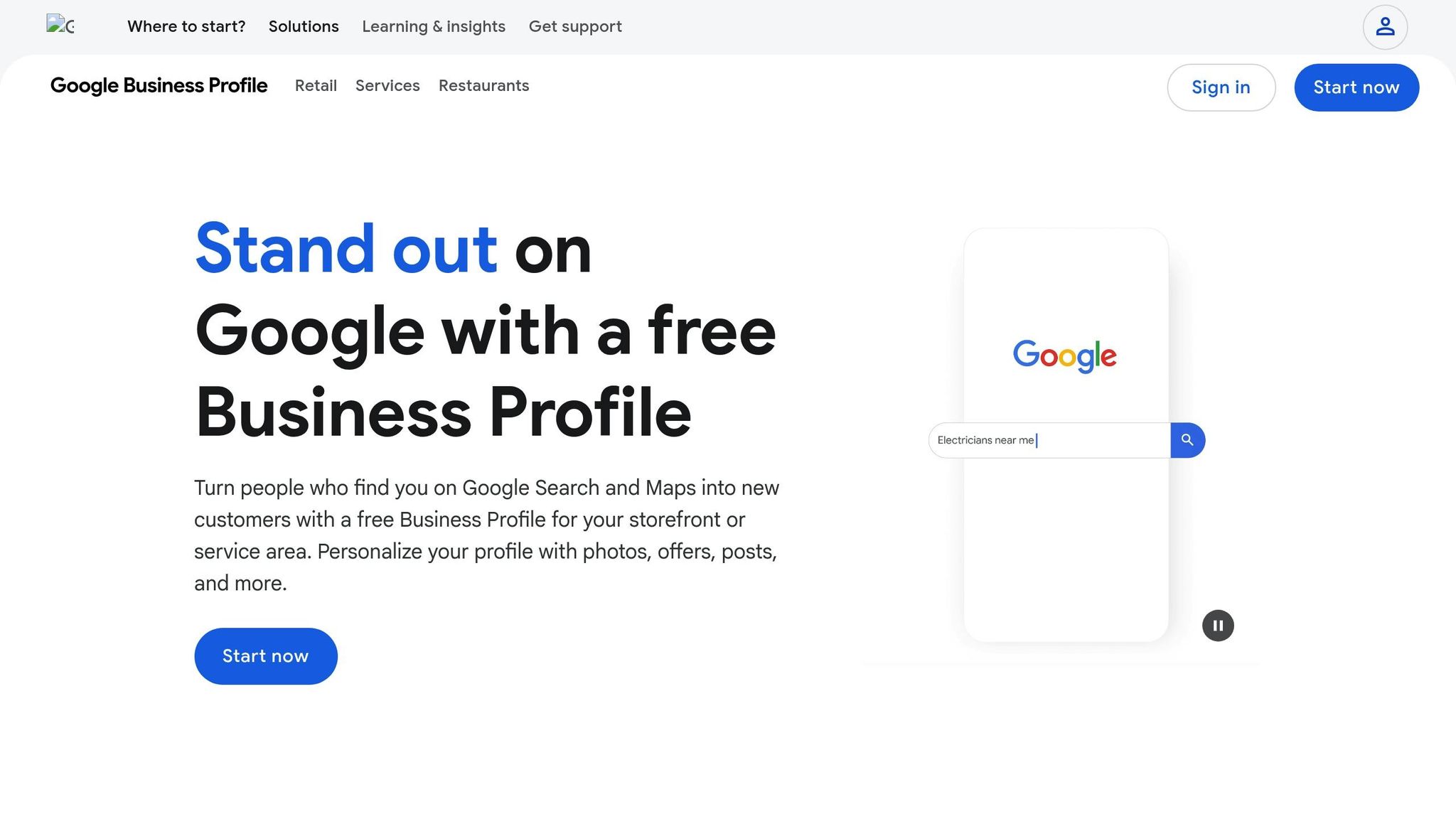
Local searches can drive up to 70% of clicks for roofing businesses that rank in the top three map results. This makes your Google Business Profile one of your most important online tools. As Adam Sand, author of the Roofing Growth Plan, explains: "Google doesn’t care about keyword density; it cares about trust, accuracy, consistency and authority". In other words, your profile needs to be more than just filled out – it has to be precise and trustworthy.
A strong foundation begins with NAP consistency (Name, Address, Phone). Your business details must be identical across your website, Google Business Profile, and every directory listing. Even small inconsistencies can hurt your credibility. Sand emphasizes: "Your Google Business Profile says you’re open until 6; your site says 5. AI sees that and docks trust". Use your exact business name without adding unnecessary keywords, list your registered business address (hiding the street address if you’re a service-area business), and ensure your local, trackable phone number is consistent across all platforms.
Your Google Business Profile is what powers the Map Pack – the three local listings that appear above organic search results. Google ranks these listings based on three key factors: relevance (how well your profile matches the search query), proximity (your location relative to the searcher or the areas you serve), and prominence (how reputable and well-known your business is).
Start by choosing "Roofing Contractor" as your primary category and only add secondary categories for services you actually offer, such as "Gutter Service" or "Skylight Contractor". Clearly list each service you provide – like roof repair, re-roofing, or chimney flashing – and include concise descriptions that highlight your expertise and specify the areas you serve. Upload high-quality photos regularly, including before-and-after shots, team photos, and images of your equipment. Frequent uploads signal to Google that your business is active and engaged.
Since nearly 9 in 10 consumers rely on online reviews, actively requesting and responding to feedback is critical. After completing a job, ask customers for reviews using a simple link or QR code, and encourage them to mention the service provided and their location. Respond to every review – thank customers for positive feedback and handle any concerns professionally. Additionally, post weekly updates through Google Posts. Share project highlights, seasonal tips, or educational content to keep your profile fresh and engaging.
While an optimized Google Business Profile builds local trust, targeting neighborhood-specific keywords helps you reach even more potential customers. With 46% of all Google searches being local, focusing on specific neighborhoods and ZIP codes can drive highly qualified traffic. Create dedicated location pages for each area you serve, ensuring the content is unique to each page. Instead of duplicating text, include details like local materials, weather challenges in that area, or recent projects you’ve completed.
Enhance these pages with location-specific images, contact details, and service hours. When homeowners search for terms like "roof repair in [neighborhood name]" or "roofer near [landmark]", these pages help you rank in both organic search results and the local pack. Adjust your Google Business Profile service areas to reflect your actual service radius, listing specific towns and ZIP codes you cover. This targeted approach allows you to dominate the neighborhoods where you want to grow, instead of competing across an entire city with larger companies.
Schema markup is a type of structured data that helps search engines understand your content more clearly. Instead of leaving room for interpretation about terms like "roof repair", schema markup explicitly defines it as a service, complete with details like pricing, service areas, and business information. This added clarity is crucial, especially for AI-driven search tools that rely on precise data.
Although schema markup doesn’t directly impact rankings, it boosts visibility by making your pages eligible for rich snippets. These enhanced search results can display star ratings, service details, and business hours, helping users find the information they need quickly. Plus, it aids AI systems in delivering accurate answers. Below, we’ll dive into the essential schema types roofing businesses should use.
To optimize your homepage and contact pages, use the LocalBusiness schema (or the more specific RoofingContractor subtype). This schema allows you to include vital details like your business name, address, phone number, website URL, logo, geo-coordinates, operating hours, price range, and links to your social profiles.
For individual service pages, the Service schema is essential. Use it to define the service name, type, provider, and service areas. If you offer multiple services, create a separate Service schema block for each one to avoid confusion. On pages featuring customer reviews, add Review and AggregateRating schema to showcase star ratings in search results. Just ensure the reviews marked up in your code match the ones visible on your site. For FAQ sections, the FAQPage schema can help AI tools extract accurate answers to common roofing-related questions. Lastly, the BreadcrumbList schema improves how your site’s structure appears in search results, making navigation easier for users.
Once you’ve identified the right schema types, implementing them correctly will make your content even more effective.
Google’s Structured Data Markup Helper is a great starting point for tagging page elements and generating JSON-LD code. Opt for the JSON-LD format – it’s Google’s preferred choice because it’s easier to manage and keeps your HTML clean. Once the tool generates your code, paste it into the <head> section of your webpage or add it through your content management system’s custom code feature.
After adding the markup, validate it using Google’s Rich Results Test. This ensures there are no errors and confirms your page qualifies for enhanced search features. Be careful to only mark up content that’s visible to users – don’t include hidden information meant solely for search engines. To strengthen your structured data, link your schema entities. For example, reference your LocalBusiness schema within your Service schema to clearly connect your business with its offerings. Lastly, make it a habit to review and update your schema regularly, especially when you change services, hours, or contact details. Keeping your structured data accurate ensures your site remains effective in search results.
Technical SEO plays a crucial role in keeping potential customers on your site long enough to take action – especially for roofing businesses. When a homeowner is dealing with a leaking roof or storm damage, they’re often searching for help on their phone in a hurry. Here’s the catch: if your site takes more than three seconds to load, over half of your mobile visitors might leave before even checking out your services.
Core Web Vitals are key metrics that influence both search rankings and user experience. These include LCP (Largest Contentful Paint) under 2.5 seconds, INP (Interaction to Next Paint) under 200 milliseconds, and CLS (Cumulative Layout Shift) below 0.1. A website that meets these benchmarks not only ranks better but also builds trust and keeps users engaged. For roofing companies, this translates into higher engagement and more conversions.
Mobile performance is especially critical. Most roofing-related searches happen on mobile devices, and with Google’s mobile-first indexing, your site’s mobile performance can make or break your conversions. Every extra second of load time can reduce conversions by 20%. On the flip side, sites that load within three seconds are much more likely to retain visitors. Considering over 70% of roofing leads come from mobile devices, a fast, technically sound site directly impacts your revenue.
Speed is everything when it comes to user retention. Start by compressing images, converting them to the WebP format, and enabling lazy loading to balance quality with speed. If you’re using WordPress, be cautious about overloading your site with multiple page builders or too many plugins, as they can bog down performance. Many roofing websites rely on heavy themes packed with unnecessary features – streamlining your design or switching to a lighter theme can make a big difference.
Enabling server and browser caching is another effective way to improve load times. If your hosting provider isn’t delivering the speed you need, consider upgrading to a faster option. Finally, take a close look at your mobile design to ensure it’s optimized for users on the go.
A responsive design is the backbone of a successful mobile site. Your website should automatically adjust to smaller screens, keeping text readable, buttons easy to tap, and the layout touch-friendly. Make sure your phone number is clickable and prominently displayed at the top of every page, so customers can reach you instantly. Navigation should be simple enough for one-handed use, and contact forms should be short and straightforward to avoid frustrating mobile users.
Avoid pop-ups on mobile – they’re often hard to close and can block critical content. Instead, use a sticky call button paired with clear calls-to-action like "Emergency Service" or "Book Estimate." Include a visible map showcasing your service area to make it easier for users to see if you’re nearby. Regularly test your site on different devices to ensure it works seamlessly across desktops, iPhones, and Androids. This is especially important since 76% of local mobile searches lead to a business visit within 24 hours. By optimizing for mobile, you’re not just improving usability – you’re also strengthening your local SEO efforts.
Keyword targeting is a key part of connecting your roofing business with homeowners who are ready to hire. It’s all about understanding the difference between someone casually browsing and someone urgently searching for help with a leaking roof. The keywords you choose determine whether your website attracts serious leads or just curious visitors.
With the rise of AI Engine Optimization, search engines now emphasize trust, accuracy, consistency, and authority over simply packing in keywords. That doesn’t mean keywords are irrelevant – they still matter, but they need to support your expertise. The real focus should be on identifying keywords that reflect immediate customer intent.
High-intent keywords are the ones that bring in homeowners who are ready to act. These include local and transactional searches like "roof repair near me", "emergency roof replacement", or "storm damage roofer Charleston SC". These are the kinds of searches made by people dealing with urgent roofing issues – not those planning for the distant future.
Start by listing every service your roofing business offers. Then, use tools like Google Keyword Planner or Semrush to find popular search terms that align with each service. Don’t just stick to the obvious – look for long-tail keywords that your competitors might overlook. Also, prioritize conversational, voice-search-friendly phrases that show clear intent.
Here’s a surprising insight: keyword research tools like Ahrefs often underestimate Cost Per Click (CPC) values for roofing-related terms by 10–20 times. This can lead to serious underbudgeting for paid campaigns. Factors like high contractor competition and seasonal demand spikes – especially during storm seasons – can significantly drive up bidding costs. Always cross-check CPC estimates with real campaign data to avoid budget missteps.
A solid keyword strategy combines specific, transactional terms for immediate conversions with broader, informational keywords to build long-term authority. For example, your service pages should target precise, high-intent phrases like "roof repair Charleston SC", while your blog posts can cover broader topics like "how to fix roof leak before rain." This approach ensures you’re reaching customers at every stage of their decision-making process. Even someone researching "signs you need a roof replacement" is likely closer to hiring than you think – make sure your website offers a free inspection or estimate to convert that interest into action.
Voice search is another area you can’t afford to ignore. Nearly half of all searches are now voice-based, often framed as "how" or "what" questions. Around 27% of people use voice search on mobile devices, and 76% of these searches include "near me" or other local terms. To capture this traffic, your keyword strategy should include conversational, question-based phrases that match how people naturally speak. By aligning your content with these patterns, you can attract an audience that traditional keyword targeting might overlook. These well-chosen keywords are the foundation of a roofing SEO strategy that delivers results.
As the digital landscape continues to shift, collaborating with experts can help ensure your roofing SEO strategy stays ahead of the curve.
Effective SEO strategies require a deep understanding of how search engines and AI evaluate roofing businesses. That’s where Blue Aspen Marketing steps in. They specialize in assisting home services companies by conducting detailed, data-driven audits that reveal key areas for improvement and opportunity. Their process begins by evaluating your online presence, including your website content, visibility in AI-driven search results, and how you stack up against competitors.
What sets them apart is their focus on realistic ROI planning. They take into account real-world business factors – like your annual revenue, marketing budget, required gross margins, and the impact of seasonal trends – to create actionable, 12-month SEO strategies tailored to your market. These plans are presented in interactive formats, allowing you to explore projections and ask questions, so there’s no guesswork involved.
Blue Aspen Marketing also tracks performance using a dual-metric system. They monitor lead indicators like AI Share of Voice and content coverage scores, alongside lag indicators such as qualified inbound calls, customer acquisition costs, and the Lifetime Gross Profit to CAC ratio. This ensures you’re not just driving traffic but converting visitors into homeowners who book appointments and contribute to your bottom line.
This thorough digital audit lays the groundwork for the custom SEO strategies that follow.
Using the insights from their audits, Blue Aspen Marketing offers three distinct packages: Foundation, Momentum, and Market Leader. Each plan includes services like technical SEO, Core Web Vitals optimization, structured data, and AI-optimized content strategies designed to meet your current needs and growth objectives.
Their approach combines AI tools with human expertise to create content that ranks in the top 10 search results. In fact, research shows that 57% of AI-generated content, when enhanced by human oversight, achieves top 10 rankings. This means you can produce content faster without losing the expertise and personal touch that both search algorithms and potential customers value.
The roofing industry is experiencing a major shift, driven by advancements in digital tools and artificial intelligence. As of September 2025, AI Overviews now appear in 44.4% of search queries, signaling a new era in how homeowners find roofing services. With Google making rapid improvements to search capabilities, staying stagnant is simply not an option. These changes emphasize the importance of adopting the strategies outlined in this guide.
Shifting to AI Engine Optimization transforms your website into an "AI résumé", helping you establish trust and authority. At the same time, your Google Business Profile remains a critical driver of roofing leads. Considering that 80–90% of roofing searches now come from mobile devices and 75% of homeowners believe AI enhances their search experience, your digital presence must function flawlessly across all platforms.
To thrive in 2026, you’ll need to blend several strategies: implementing schema markup, creating localized content, earning steady positive reviews, and ensuring fast mobile performance. These elements are crucial for maintaining visibility and connecting with homeowners when they’re actively searching for roofing solutions.
The roofing market is undeniably competitive, with homeowners having plenty of choices at their fingertips. Companies that embrace AI-driven search, focus on local optimization, and maintain technical excellence will secure more leads. On the other hand, neglecting these trends could result in wasted marketing efforts and losing ground to competitors who are already adapting.
This guide underscores the importance of integrating AI and local SEO strategies. Whether you choose to implement these changes internally or collaborate with experts, the time to act is now. The digital landscape is evolving quickly, and so are the homeowners looking for their next roofing contractor.
In 2026, roofers can take advantage of AI-powered tools to refine their keyword research. These tools can pinpoint relevant search terms, analyze what users are looking for, and highlight gaps in existing content. This means roofers can quickly identify high-value, low-competition keywords that cater to the needs of their local customers.
By using carefully crafted prompts, roofers can also leverage AI for competitor analysis, uncover new keyword opportunities, and automate the process of gathering data. This streamlined method supports a strategy based on actionable insights, helping roofers connect with the right audience and boost their local search rankings.
To make your roofing website stand out in voice search results, focus on natural, conversational language that aligns with how people speak to voice assistants. Incorporate long-tail keywords and common questions into your content. Adding FAQ schema markup can also help search engines better understand your site, making it easier for users to find the answers they’re looking for. And don’t forget to keep your Google Business Profile updated with accurate and detailed information about your business.
Another key area to tackle is local SEO. Use location-based keywords and optimize your content to appear in featured snippets, which are prime real estate for voice search queries. On the technical side, ensure your website is in top shape with fast loading speeds, mobile-friendly design, and intuitive navigation. These improvements not only enhance the user experience but also increase your chances of attracting local customers searching for roofing services.
Optimizing your Google Business Profile is key to boosting your visibility in local searches. For roofing businesses, this can mean securing a spot in Google’s local "Map Pack" – that prominent section people see first when searching for nearby services.
A polished profile does more than just put your business on the map. It builds trust, simplifies how customers can reach you, and encourages actions like phone calls, website clicks, or even walk-ins. By keeping your profile accurate, uploading engaging photos, and sharing regular updates, you can set yourself apart from the competition and draw in more local clients.


 Physical Therapy
 MedSpa
 Dental
 HVAC
HVAC Roofing
 Pest Control
 Cleaning Services
 Landscaping
 Hotel
Hotel Cruise
 Branding
 Content Marketing
 Email Marketing
 Graphic Design
 PPC (Online Ads)
 SEO (Search Engine Optimization)
 Website Design and Development
 Pest Control
 Plastic Surgeon
 Roofing