The way people find HVAC services has evolved. In 2026, local search and mobile-first strategies dominate. Homeowners rely on conversational queries like “Why is my AC not cooling?” and expect fast, clear answers. If your HVAC business isn’t visible at the top of search results, you’re missing out on leads – especially during emergencies. Here’s what you need to know:
In 2026, a strong SEO strategy isn’t optional – it’s the foundation for growing your HVAC business and reducing lead costs. Focus on visibility, speed, and customer trust to stay ahead.
2026 HVAC SEO Statistics and Key Performance Benchmarks
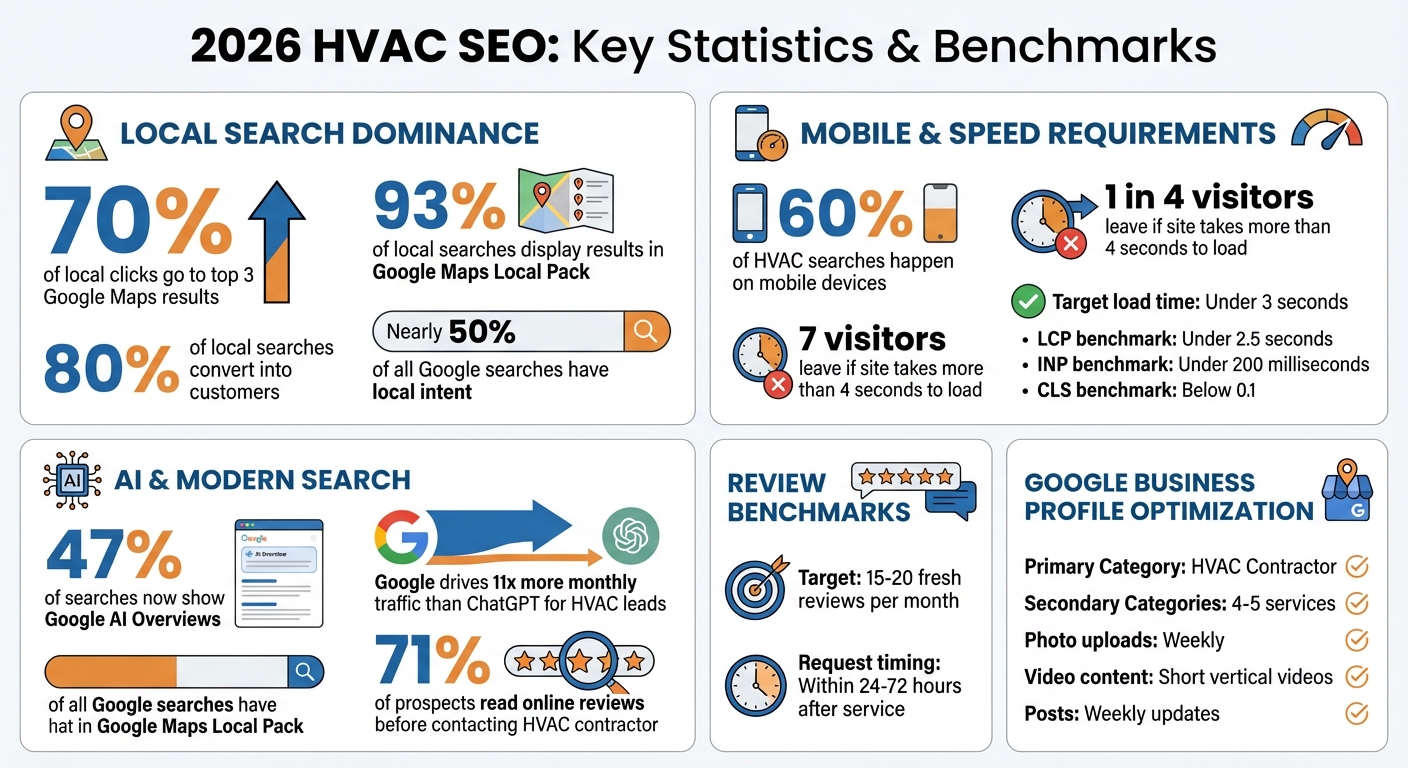
When a furnace gives out on a freezing January night, most people aren’t scrolling endlessly through search results. They’re clicking on one of the top three businesses in Google’s Map Pack, which grabs a whopping 70% of local clicks. If your business isn’t in that top three, you could be missing out on a fully booked schedule.
Local SEO helps Google understand your service area, your offerings, and why customers trust you. This foundation is key for optimizing tools like your Google Business Profile and creating localized landing pages.
Think of your Google Business Profile (GBP) as your online storefront – it’s where local visibility begins. Start by setting your primary category to "HVAC Contractor". Then, add 4–5 secondary categories like "Air Conditioning Repair Service", "Heating Contractor", and "Furnace Repair Service" to broaden your keyword reach.
Don’t stop there. Add all relevant services, such as duct cleaning, thermostat installation, and heat pump repair, to strengthen your profile. Also, ensure your business name, address, and phone number (NAP) are consistent across all platforms. Even minor variations like “St.” versus “Street” can confuse Google and hurt your rankings.
By 2026, Google is favoring short vertical videos over static images in GBP feeds. Upload high-quality visuals weekly – show off your branded trucks, uniformed technicians, and before-and-after shots of completed jobs. Use the "Posts" feature weekly to share seasonal promotions (like spring tune-up discounts) and company updates. Enable messaging so potential customers can request quotes directly, and fill the Q&A section with answers to common questions about pricing and financing.
Here’s a quick guide to what matters most for your GBP in 2026:
| Feature | Optimization |
|---|---|
| Primary Category | Set as "HVAC Contractor" |
| Secondary Categories | Add 4–5 services like "Furnace Repair" or "AC Installation" |
| Photo Frequency | Upload weekly images of team members, trucks, and job sites |
| Video Content | Post short vertical videos of technicians at work |
| Review Goal | Aim for 15–20 fresh reviews per month |
| Google Posts | Weekly updates with seasonal offers and safety tips |
To stay ahead, use tools like GMB Everywhere to analyze your top competitors’ GBP categories. Monitor your visibility using Local Falcon or GMB Dominator, running 7×7 or 9×9 ranking grids every two weeks to identify weak spots (or "red zones"). Adjust your categories seasonally – highlight "Heating Contractor" in winter and "Air Conditioning Repair Service" in summer.
Once your GBP is fully optimized, shift your focus to creating location-specific landing pages for even better local reach.
Gone are the days when a generic service page was enough. Google now rewards businesses that create hyper-localized content tailored to each city or neighborhood. Instead of one broad "service area" page, build targeted landing pages for each core service in each city you serve. For example, "Emergency AC Repair in Frisco, TX" or "Furnace Installation in Plano, TX".
Each page should feel personal. Mention specific neighborhoods, landmarks, or housing types in your introduction. Use hyper-local keywords in your title tags and headings, such as "[City] Furnace Repair" or "[Neighborhood] AC Installation". Include testimonials from local customers and photos of your team working in the area. Embed a Google Map with a pin for the target location and make sure "Click-to-Call" buttons are easy to find for mobile users.
Case studies show the power of local SEO. Between 2024 and 2025, WebSpero Solutions helped Moyle Plumbing & Gasfitting achieve a 468.21% increase in new users and a 472.33% jump in overall users within a year. Similarly, Built Right Digital’s strategy for an HVAC provider in Miami boosted keyword positions by 32%, organic traffic by 15%, and leads by 22% in 2025.
To build relevance, reference local housing types or unique needs. For instance, mention "serving historic homes in [Neighborhood]" or "trusted by homeowners in [Subdivision]". Add a Q&A section addressing local concerns, like diagnostic fees or financing options. Use LocalBusiness and Service schema markup to make your service areas crystal clear to search engines. Also, make sure your pages load in under three seconds and include a sticky footer with a clickable phone number for emergencies.
Timing is everything when it comes to reviews. Request feedback within 24 to 72 hours of service completion while the experience is still fresh. Use tools like Birdeye, Podium, or Nice Job to send one-click review requests via SMS or email. Encourage customers to mention the specific service and city in their reviews – phrases like "emergency furnace repair in Dallas" can help Google connect your business to long-tail searches. Train technicians to ask for reviews on-site and even consider incentivizing them to do so.
Respond to every review – positive or negative. For negative ones, stay professional: acknowledge the issue, apologize, and offer a solution offline. For example, "We’re sorry for your experience. Please call us at [Phone] so we can make it right". This shows both customers and Google that you’re engaged and proactive, boosting your profile’s activity score.
The results speak for themselves. In December 2025, PneuTech, an HVAC client, saw a 720% increase in organic qualified leads and a 46% drop in marketing lead costs after an SEO overhaul led by Ivan Vislavskiy at Comrade Digital Marketing. This highlights how review management isn’t just about reputation – it’s a direct driver of leads and revenue.
While Google is the priority, don’t overlook platforms like Yelp, Angi, and HVAC.com. With 71% of prospects reading online reviews before contacting an HVAC contractor, and many trusting online reviews as much as personal recommendations, a strong review strategy can make all the difference in a competitive market.
On-page SEO transforms search visibility into actionable leads. For HVAC companies in 2026, success often boils down to three essentials: targeting the right keywords, publishing content that meets customer needs at the right time, and ensuring visitors can easily find the information they’re after.
Not all keywords are created equal when it comes to turning searches into sales. For example, problem-focused searches like "AC not blowing cold air" or "furnace making loud noise" often indicate an immediate need for professional help. On the other hand, informational queries, such as "how to change HVAC filter", tend to attract users who are just browsing.
The sweet spot for HVAC businesses lies in service-oriented terms that capture buyers actively seeking solutions. Phrases like "ductless mini-split installer", "emergency AC repair near me", or "heat pump repair" are goldmines for leads. Tools like SEMrush, Ahrefs, and Google Keyword Planner can help you zero in on high-traffic keywords relevant to your service area. Additionally, listening to the exact phrases customers use during service calls can reveal high-conversion keywords like "AC installation cost" or "HVAC replacement financing."
Local targeting is another must. With 80% of local searches converting into customers and nearly half of all Google searches driven by local intent, tailoring your content for specific geographic areas is critical.
Keep an eye on seasonal keyword trends using Google Trends. For instance, searches for "AC tune-up" typically spike in the spring, while "furnace safety check" gains traction in the fall. In 2026, consider creating content around the R-410A refrigerant phase-out and the transition to R-32 or R-454B. This regulatory shift is becoming a hot topic, and addressing it positions your company as forward-thinking and informed.
Once you’ve identified your target keywords, align your content strategy with seasonal customer needs.
HVAC demand ebbs and flows with the weather. As Hunter Colby from The Ad Firm explains:
"HVAC searches spike during extreme weather conditions. A heat wave sends air conditioning repair queries soaring within hours, not weeks."
To stay ahead, your content strategy should adapt to these shifts. For example, early in the year, focus on guides like "Preparing Your AC for Summer" to address springtime needs. By May and June, prioritize content on AC repair and installation, as demand peaks. In late summer, pivot to articles like "Preparing Your Furnace for Winter," and as fall arrives, roll out heating maintenance checklists. During winter, emergency heating topics, such as "no heat troubleshooting," take center stage.
A great example of this approach comes from Workshop Digital’s partnership with home services company Woodfin. Between 2014 and 2021, they implemented a seasonal content strategy, including a snowstorm-themed campaign that generated over 3,400 qualified leads and delivered a 19× ROI in 2021. This case study highlights the power of timely, weather-triggered content to capture customer attention during high-demand periods.
Seasonal content doesn’t have to live solely on your blog. Use Google Business Profile posts to share offers like "10% off AC Tune-ups" in the spring or "24/7 Emergency Furnace Repair" in the winter. Share weekly photos and brief vertical videos showcasing your team in action on seasonal projects. Google’s algorithm in 2026 favors businesses that regularly post relevant updates, so staying active can boost your visibility. Balance emergency-focused content with educational pieces like "Signs You Need a New AC" or "How Often to Replace Your HVAC Filter," which help build trust and authority over time.
Once your content is dialed in, make sure your site’s navigation helps visitors easily find the services they need.
Internal links play a dual role: they guide visitors to the right pages and help search engines understand your site’s structure. The goal is simple – any visitor should be able to reach a key service page within two clicks from anywhere on your site.
Start by organizing your navigation around clear service categories like Heating, Cooling, and Air Quality. Each primary service page should include 3–5 internal links, and your footer should feature a Service Areas section to connect all location-specific pages, preventing them from becoming isolated or "orphaned."
Contextual links are another powerful tool. For instance, a blog post on "How to Clean an AC Filter" can link directly to your Professional AC Maintenance page, guiding readers toward your services. Similarly, address common customer concerns by linking to pages about Financing Options, 24/7 Emergency Services, or certifications and warranties. These links build trust and make it easier for customers to take the next step.
Regularly audit your site using tools like Google Search Console or Ahrefs to catch and fix broken links. Broken links not only frustrate visitors but can also hurt your rankings. Considering that 93% of local searches display results in the Google Maps Local Pack, a well-structured internal linking strategy can directly impact your chances of appearing in those coveted top results.
Technical SEO forms the backbone of a fast and easily discoverable HVAC website. As of 2026, Google primarily evaluates the mobile version of your site for rankings. This means that if your site isn’t mobile-friendly, it won’t rank well – no matter how great your content is.
And the stakes? They’re high. Nearly 60% of all HVAC-related searches happen on mobile devices. Worse, one in four visitors will leave your site if it takes more than four seconds to load. Safa Tash from NOVA Advertising sums it up perfectly:
"A slow website is a lost lead".
So, what’s next? Let’s dive into how to ensure your site’s mobile design and speed are ready to meet user demands – especially during emergencies.
Your website needs to load in 3 seconds or less. Anything slower risks losing potential customers. Tools like PageSpeed Insights can help you address common issues like oversized images, uncompressed files, and unminified JavaScript. Aim for these benchmarks:
For HVAC companies, mobile optimization is critical during emergencies. Think about it – when someone’s AC breaks down at 2 a.m. in the middle of July, they’re stressed, on their phone, and looking for a quick solution. Make sure key action buttons like “AC Repair” are easy to find and accessible in two taps or less. Adding a "sticky" footer can keep navigation elements in view, ensuring users can act quickly.
To further improve speed, consider these steps:
Once your site is fast and mobile-ready, the next step is to make it smarter with structured data.
Schema markup helps search engines understand your business better – what you do, where you’re located, and how customers perceive you. It’s essential for appearing in rich search results, like snippets with star ratings.
For HVAC businesses, four types of schema markup are especially useful:
Apply schema types only to relevant pages. For example, include precise latitude and longitude coordinates in your LocalBusiness schema to improve local map rankings. Use tools like Google’s Rich Results Test or a Schema Validator to catch errors. Also, double-check that your CDN or robots.txt file isn’t blocking bots like Google Gemini from accessing your structured data.
A well-structured site with detailed schema ensures that search engines can crawl your site smoothly.
Search engines can’t rank what they can’t find. That’s where your XML sitemap comes in – it’s like a roadmap for search engines, outlining all your key service and location pages. Submit it through Google Search Console and update it whenever you add new content.
Your robots.txt file is another critical tool. It tells search engines which pages to crawl and which to ignore. Optimize it to focus on high-value content, like service and location pages, while skipping low-priority areas such as admin panels or duplicate pages. Regularly audit for 404 errors to keep your site healthy.
Security also plays a big role in rankings. Google prioritizes HTTPS-secured websites, and customers trust sites with the padlock icon in their browser. An SSL certificate is a must-have. Additionally, ensure your CDN settings don’t block AI bots like Google Gemini, which use advanced methods like “query-fan out” to search multiple terms at once. Blocking these bots could mean missing out on AI-generated search overviews.
| Technical Element | Purpose for HVAC SEO | Recommended Tool |
|---|---|---|
| Page Speed | Reduces bounce rates during emergencies | PageSpeed Insights |
| Schema Markup | Displays star ratings and service details | TechnicalSEO.com Generator |
| XML Sitemap | Helps Google find all service and location pages | Google Search Console |
| Mobile UX | Ensures click-to-call works during emergencies | Google Mobile-Friendly Test |
| AI Crawlability | Ensures visibility in AI-driven search results | Gemini/GPT Bot Access |
AI is becoming a game-changer for HVAC businesses, complementing both local and technical SEO strategies. With Google AI Overviews now appearing in up to 47% of all searches, it’s clear that your content must cater to both human readers and AI systems. Jennifer Bagley, CEO of CI Web Group, sums it up perfectly:
"AI SEO for HVAC is changing how heating and cooling companies get found online… moving away from traditional keyword-focused results."
While traditional SEO remains vital, the integration of AI-friendly strategies is no longer optional. For example, Google still drives 11 times more monthly traffic than ChatGPT when it comes to HVAC lead generation.
AI tools like ChatGPT and Gemini are reshaping how keyword research is done. Instead of sticking to basic terms like "AC repair", these tools uncover natural, conversational queries like "Why is my air conditioner blowing warm air?" AI also shines at finding long-tail phrases, such as replacing the broad "furnace maintenance" with more specific phrases like "furnace making loud noise".
With AI, you can create topic clusters around key services and generate FAQ content that tackles common customer questions, such as "How much does a diagnostic visit cost?" or "Why won’t my air conditioner start?". This approach not only improves SEO but also addresses real customer concerns.
Appearing in AI-generated search results requires a shift in strategy. It’s not just about ranking high – it’s about becoming the source AI platforms trust for their synthesized answers.
To achieve this, implement schema markup like HVACBusiness, Service, FAQPage, and Review to make your content more readable for AI systems. This helps position your business as a credible source for AI-generated responses. For voice search optimization, aim for FAQ answers that are 40–60 words long, as this is the ideal length for voice assistants to read aloud.
Write in a natural, conversational tone to explain HVAC topics clearly. Demonstrate E-E-A-T (Experience, Expertise, Authoritativeness, and Trustworthiness) by providing verifiable proof, such as jobsite photos with geo-coordinates and detailed descriptions of completed work. Also, ensure your NAP (Name, Address, Phone number) information is consistent across platforms like Google Business Profile, Yelp, and Facebook. This builds trust with both users and AI systems.
By leveraging AI strategies, you can also automate repetitive tasks, freeing up time for more critical efforts.
AI isn’t just transforming keyword research and content creation – it’s also streamlining routine SEO tasks. Automation tools can handle repetitive processes, allowing you to focus on customer service and other high-priority activities. Tools like Rankability and Surfer SEO use natural language processing (NLP) to provide real-time scoring and suggest semantic keywords.
For tracking local performance, tools such as Local Falcon and GMB Dominator offer AI-driven grid tracking, showing how your business ranks on local maps down to specific neighborhoods. This granular data helps you fine-tune your strategy by identifying traffic-driving ZIP codes.
| Tool | Best For | Starting Price |
|---|---|---|
| Rankability | Agencies needing NLP accuracy | $149/month |
| Surfer SEO | Content teams seeking real-time scoring | $99/month |
| Frase | Budget-conscious businesses | $45/month |
| Local Falcon | Hyper-local map tracking | Varies |
Automation extends to review management too. Use post-service SMS or email prompts to collect reviews consistently. Maintaining a steady "review velocity" is expected to remain a major ranking factor through 2026. Tools like Writesonic can help you draft review response templates that align with your brand voice while saving time.
For businesses with high content demands, AirOps simplifies scaling by automating tasks like content briefs, SERP analysis, and initial drafts. This ensures you can produce quality content at scale without sacrificing efficiency.
Pulling all the pieces of your HVAC SEO strategy together, the takeaway is clear: a unified approach is essential. SEO in 2026 isn’t about isolated tactics – it’s about creating an interconnected system that works seamlessly to grow your business. Think of it this way: your Google Business Profile boosts visibility, your website turns visitors into booked appointments, consistent reviews build trust, and fast loading speeds keep potential customers engaged. Each piece strengthens the others, creating a powerful cycle of success.
Neglecting your digital presence? That’s like handing over ready-to-buy customers to your competitors.
"HVAC SEO isn’t just about keywords; it’s about creating a fast, user-friendly website, building trust through reviews, and making it easy for customers to contact you." – Jennifer Bagley, CEO, CI Web Group
Unlike paid ads that require constant spending, a well-rounded SEO strategy works 24/7 to bring in leads. Whether you’re refining your GBP categories, adding schema markup, or crafting conversational content for AI-driven search overviews, every effort strengthens your market position.
Start by focusing on the fundamentals: optimize your site to load in under three seconds, ensure your NAP (Name, Address, Phone) is consistent everywhere, and automate review collection to secure 15–20 new reviews each month. From there, lean into emerging trends like creating content around the 2026 refrigerant phase-out and incorporating vertical video updates for your GBP. The HVAC businesses that treat SEO as a dynamic, interconnected system – not just a checklist – will lead their local markets in 2026 and beyond. Now’s the time to embrace this strategy and secure your edge for the future.
To get the most out of your Google Business Profile (GBP) for local SEO in 2026, start by choosing a primary category that aligns with your main service – like HVAC contractor. Then, add secondary categories to cover specific services, such as air conditioning repair, furnace installation, or indoor air quality solutions. Double-check that your profile’s details – business name, address, and phone number (NAP) – are 100% accurate and match the information on your website and other listings. In your service descriptions, include locally targeted keywords, like AC repair in [City] or furnace installation near [ZIP], and list all the areas you serve to boost your visibility in local search results.
Keep your profile active by uploading fresh photos regularly. Share images of recent projects, your team in action, or branded vehicles to give your profile a personal touch. Post updates about seasonal deals, special offers, or emergency services to keep potential customers engaged. Encourage happy customers to leave reviews, and make it a point to respond to every review – whether positive or negative. Use the Q&A section to address common questions, such as Do you offer 24/7 service?. By staying consistent, interacting with your audience, and using location-based keywords, your HVAC business can stand out and attract more high-intent leads in 2026.
AI is transforming the way HVAC businesses approach SEO, moving the focus from basic keywords to truly understanding user intent and how people naturally phrase their questions. These days, homeowners are more likely to type out detailed, conversational queries like "Why is my furnace blowing cold air, and who can fix it today?" instead of relying on short, generic terms. To stay ahead in this changing landscape, HVAC companies need to adapt by optimizing for these conversational search trends and emphasizing E-E-A-T – Experience, Expertise, Authoritativeness, and Trust – factors that AI algorithms now heavily weigh.
AI-powered tools are proving invaluable at every step of the SEO process. They help identify highly specific, hyper-local keywords and assist in creating engaging, voice-search-friendly content that directly addresses common homeowner questions. By incorporating techniques such as structured data markup and producing content tailored to align with AI-generated summaries, HVAC businesses can improve their search rankings, draw in more local traffic, and ultimately book more service calls.
Mobile optimization is a game-changer for HVAC businesses in 2026. Why? Because when someone’s air conditioner suddenly stops working or their furnace needs urgent attention, they’re grabbing their smartphone to find a solution – fast. If your website isn’t mobile-friendly, you’re likely losing potential customers to competitors who make it easier to connect.
Here’s the reality: more than half of HVAC-related searches happen on mobile devices. If your site loads slowly or feels clunky to navigate, visitors won’t stick around. A responsive, fast-loading website ensures a smoother experience, which not only keeps users happy but also boosts your visibility in Google’s mobile-first indexing. That means better rankings and more chances to appear in local search results.
To stand out, focus on mobile-friendly features like clickable contact buttons, clear service pages, and easy online scheduling. These small but impactful details can help turn mobile visitors into leads – and leads into loyal customers – all year long.


 Physical Therapy
 MedSpa
 Dental
 HVAC
HVAC Roofing
 Pest Control
 Cleaning Services
 Landscaping
 Hotel
Hotel Cruise
 Branding
 Content Marketing
 Email Marketing
 Graphic Design
 PPC (Online Ads)
 SEO (Search Engine Optimization)
 Website Design and Development
 Pest Control
 Plastic Surgeon
 Roofing