Local pest control businesses can gain more customers with a well-optimized Google Business Profile (GBP). Here’s why it matters and how to make it work:
Key Tips for Success:
For pest control companies, an optimized GBP means more visibility, trust, and leads – all without spending on ads.
Google Business Profile Impact Statistics for Pest Control Companies
Setting up your Google Business Profile the right way from the beginning can save you from headaches later. It ensures that customers can find you easily when they need your services. While the process is simple, precision is key – any inconsistencies in your information could harm your local search rankings and confuse potential customers. Let’s walk through how to select the best categories and input your business details accurately.
Getting your categories and attributes right is essential for success in local search. Start with your primary category as "Pest Control Service." This signals to Google exactly what your business does and helps it show up in the right searches. Beyond that, you can add secondary categories to highlight specific services, such as:
The more specific your categories, the better your chances of appearing in searches for those exact services.
Attributes are another valuable tool for showcasing what makes your business stand out. Highlight features like emergency services, online scheduling, free estimates, same-day service, or accessibility options like a wheelchair-friendly entrance. Additionally, Google’s newer 2025 attributes let you emphasize unique qualities such as being women-led, veteran-owned, family-owned, or eco-conscious. These details can help your profile feel more modern and appealing to potential customers.
Your business’s core information – commonly referred to as NAP (Name, Address, Phone Number) – needs to be consistent across all platforms. Even small differences, like using "St." on one platform and "Street" on another, can impact your rankings. Make sure every detail is uniform.
Also, specify a clear service radius and include your business hours. If you offer 24/7 emergency services, be sure to mention that as well. Accuracy here ensures customers know when and where they can rely on you.
Once your basic details are in place, you’ll want to craft a compelling, location-focused description for your business.
Your business description is your chance to tell customers what you do, where you operate, and why they should choose you. Start by outlining your main services and the areas you serve:
"[Company Name] delivers expert pest control services in [Service Area]. Specializing in [Key Services], our licensed technicians provide effective solutions for [Common Pest Problems]. Proudly serving [Neighborhoods/Areas] with [X] years of experience, we stand out with [Unique Value Proposition]."
Incorporate natural variations like "pest management" or "extermination services" to keep the language varied but relevant. Mention specific neighborhoods and local pest challenges – like termite issues in humid areas or rodent infestations in older buildings. Highlight what makes your business stand out, whether it’s fast response times, safety certifications, guarantees, or eco-friendly practices. Keep your description concise, clear, and focused to improve your local search visibility while staying compliant with Google’s guidelines.
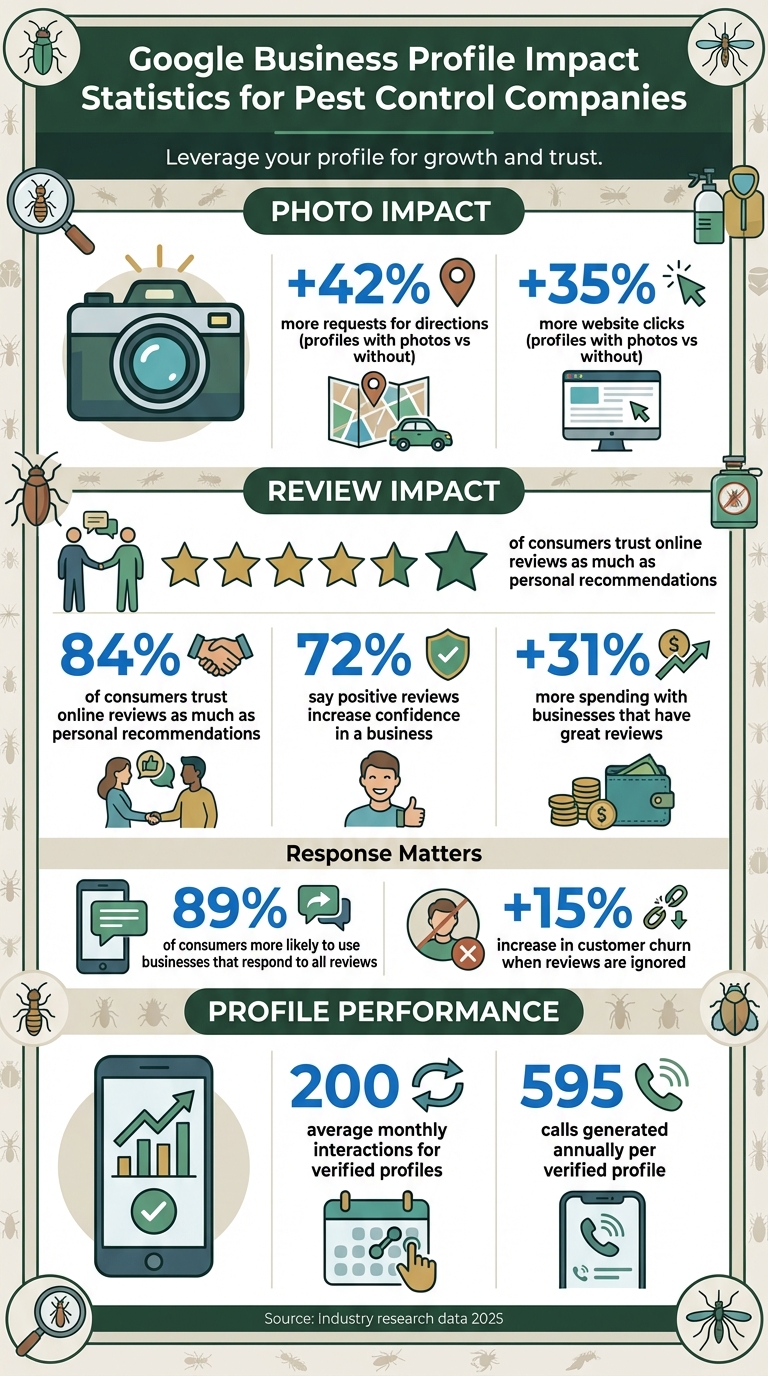
Visual content plays a huge role in shaping a customer’s first impression of your pest control business. Profiles that feature photos get 42% more requests for directions and 35% more clicks to their websites compared to those without them. Pairing compelling images with detailed service listings helps potential customers feel confident in choosing your services.
Showcasing your team in action can go a long way in building trust. Include photos of technicians in branded uniforms performing inspections or treatments – this not only highlights professionalism but also makes your team easily recognizable. For example, in July 2025, ohDEER effectively used images of their technicians wearing branded uniforms and operating branded trucks with clear contact details, turning every photo into a marketing tool.
Before-and-after shots of pest removal results are another great way to demonstrate your expertise. Adding images of your branded vehicles, equipment, and eco-friendly products can further reinforce trust. To keep your profile fresh, update your photo gallery often. Since most customers browse on mobile devices, ensure your images are optimized for vertical viewing. For better local search rankings, use descriptive file names like "termite-treatment-dallas-tx.jpg".
Pair these visuals with clear, detailed service descriptions to maximize your local reach.
When listing your services, be specific. Instead of a broad "General Pest Control" category, break it down into individual services like "Termite Treatment" or "Bed Bug Removal." Each listing should include a concise, keyword-rich description and pricing details such as "Starting at $150" or "Free inspection with treatment".
Consistency in naming is key. Incorporate location-specific terms like "Dallas termite inspections" or "Houston mosquito prevention" to make it easier for local customers to find your services. The more precise your listings, the better you can meet customer needs.
Adapt your service listings to address seasonal pest problems. For example, focus on termite alerts and inspections in early spring, mosquito and ant control in late spring and summer, rodent exclusion in the fall, and indoor pest management or bed bug treatments during winter. Regional adjustments are also important – for instance, termite issues are a year-round concern in the Southeast, while coastal areas might face humidity-related pests, and Phoenix may deal with monsoon-driven infestations.
Customer reviews are a powerful tool for building trust. In fact, 84% of consumers trust online reviews as much as personal recommendations, and 72% say positive reviews increase their confidence in a business. Plus, customers tend to spend 31% more with businesses that have great reviews.
Encouraging satisfied customers to leave reviews can make a huge difference. Ask them immediately after their service – this can be done via text, email, or even a QR code printed on receipts. Train technicians to request reviews as soon as they’ve completed a job.
However, avoid offering discounts or incentives for reviews – this violates Google’s policies. Instead, focus on delivering top-notch service and timing your request well. To make reviews more engaging, encourage customers to include photos. For example, if you’ve cleaned or treated a specific area, ensure it’s spotless and professional-looking to inspire before-and-after pictures.
Responding to reviews is equally important. Did you know that 89% of consumers are more likely to use a business that responds to all reviews, and ignoring reviews could lead to a 15% increase in customer churn? A thoughtful response shows you care. For instance, if a customer mentions ongoing pest issues after treatment, you could reply like this:
"Hi [Customer Name],
Thank you for sharing your experience. We’re very sorry to hear that you’re still seeing ants after our treatment. This isn’t the level of service we aim to provide. Please call me, [Your Name], directly at [phone number] so we can address this promptly.
Sincerely,
[Your Name], Owner, [Your Company]"
This approach acknowledges the issue, apologizes sincerely, and invites the customer to resolve the matter privately.
"If you look at two businesses side by side, one is getting responded to in a timely manner and one is not, who do you think the customer’s gonna choose?"
– Avram Gonzales, Chief Strategist of Digital Harvest
When it comes to pest control emergencies, quick communication is key. Enable the messaging feature on your Google Business Profile so customers can contact you directly through Google Search or Maps. To handle after-hours inquiries, set up automated replies, and during business hours, ensure your team actively monitors messages.
Make it easy for customers to reach you by adding prominent call and website buttons to your profile. These one-click options are invaluable for customers dealing with urgent infestations. The simpler you make the process, the more likely you are to convert potential leads into loyal clients.
Google Posts are a great way to directly connect with potential customers browsing your profile. They grab attention by combining an eye-catching image with a timely offer. To make the most of them, align your posts with seasonal pest trends. For example:
Each post should include a seasonal topic, a clear call to action, a striking image, and details about any current promotions. For instance, a July post could say: "Mosquitoes ruining your backyard BBQs? Get 20% off our summer mosquito treatment through 7/31/2025. Call now: (555) 123-4567."
Your Google Business Profile offers valuable tools to see how customers interact with your listing. On average, verified profiles receive 200 interactions monthly and generate 595 calls annually. By tracking metrics like website clicks, calls, and requests for directions, you can identify what’s working. For example, if a post about a specific service leads to a spike in direction requests, it’s a sign your content is hitting the mark.
Photos are also incredibly effective at driving engagement. Regularly review your metrics to spot patterns and adjust your strategy. Don’t forget to monitor your reviews and ratings – they play a big role in your local search visibility. If managing all of this feels like too much, professional help can make a difference.
Even with detailed insights, keeping up with your Google Business Profile can be challenging. That’s where Blue Aspen Marketing comes in. They specialize in local SEO and digital marketing, offering services like PPC ad campaigns, website optimization, and email marketing. Their expertise ensures that your profile isn’t just optimized – it’s part of a larger strategy.
Your Google Business Profile isn’t just a simple listing – it’s your online storefront and often the first thing potential customers see when searching for pest control services. A well-optimized profile lays the groundwork for strong local visibility and helps you connect with people actively looking for your services.
Every detail matters. From listing your services clearly to posting seasonal updates, each element contributes to making your profile stand out. These strategies build trust and attract customers, giving you an edge over competitors with incomplete or neglected profiles.
Keeping your profile consistent and up-to-date is key. Ensuring your business information matches across platforms and responding promptly to reviews boosts both your search ranking and customer confidence. Google’s algorithm favors active, well-maintained profiles, and customers value businesses that show professionalism and care.
"An optimized GBP listing isn’t a ‘set it and forget it’ asset – it requires ongoing maintenance, just like your pest control equipment." – Cube Creative Design
As you implement these strategies, remember that managing your profile is an ongoing process. Google regularly introduces new features, pest activity changes with the seasons, and customer expectations evolve. Whether you handle updates yourself or partner with Blue Aspen Marketing, staying on top of these changes ensures your profile continues to drive local growth.
To draw in more local customers, pest control companies should make the most of their Google Business Profile by focusing on a few key areas:
You can also take advantage of features like posts to share updates, the Q&A section to address common customer questions, and messaging to make it easier for potential customers to reach out. Regularly updating and managing your profile while keeping details consistent across platforms can go a long way in improving local visibility and engaging more customers.
Managing reviews on your Google Business Profile plays a crucial role in building trust and drawing in more customers. Make it a priority to respond quickly and professionally to every review. Show gratitude for positive feedback – it not only acknowledges your customers but also helps strengthen their loyalty. When dealing with negative reviews, approach them with understanding and a focus on resolving the issue. This shows your dedication to keeping customers happy.
If you spot spam or inappropriate reviews, use the report feature to flag them for removal. You can also shine a spotlight on your best reviews by featuring them in your marketing materials or on social media. It’s a great way to highlight your credibility and the quality of your service.
Maintaining consistent business information across all platforms is key to building trust with Google and boosting your local search rankings. When your business name, address, and phone number (NAP) are uniform everywhere, it sends a strong message of reliability to search engines. Plus, it ensures customers can find accurate details about your business.
Consistency eliminates confusion for potential customers, making it easier for them to reach out or visit your location. This clarity not only reinforces your credibility but also helps you attract more local leads and foster better customer engagement.


 Physical Therapy
 MedSpa
 Dental
 HVAC
HVAC Roofing
 Pest Control
 Cleaning Services
 Landscaping
 Hotel
Hotel Cruise
 Branding
 Content Marketing
 Email Marketing
 Graphic Design
 PPC (Online Ads)
 SEO (Search Engine Optimization)
 Website Design and Development
 Pest Control
 Plastic Surgeon
 Roofing