Responding to online reviews is essential for small and medium-sized businesses (SMBs). Why? Because 93% of consumers say reviews influence their buying decisions, and 84% trust them as much as personal recommendations. Engaging with reviews – whether positive or negative – can help you build trust, improve your local SEO, and even boost revenue. Here’s what you need to know:
Using ready-to-go templates can save time while ensuring your replies are professional and customer-focused. Whether you’re thanking a loyal customer or addressing critical feedback, thoughtful responses can improve your reputation and attract more business. Pro tip: Personalize each response with the reviewer’s name and specific details to show you care.
Keep reading for examples of templates tailored for every type of review, plus tips to make them work for your business.
Before diving into templates, it’s crucial to understand some core principles for responding to reviews. Whether you’re thanking a loyal customer or addressing a complaint, these guidelines can make the difference between turning a reviewer into a repeat customer – or losing them entirely. Think of these as the foundation for using specific response templates effectively.
Every review response is public, meaning potential customers might read it before deciding to engage with your business. According to a 2022 BrightLocal survey, 89% of consumers are more likely to use a business that responds to all its online reviews, while 57% say they’ll avoid a business that doesn’t respond at all. This underscores how crucial it is to maintain a professional tone.
Even when faced with tough feedback, your reply should stay calm, respectful, and solution-oriented. Avoid defensive or emotional responses like "This isn’t our fault" or "You’re wrong about what happened." Instead, use empathetic language like, "We’re sorry to hear about your experience" or "We understand your frustration and would love the opportunity to make it right". A professional response to a negative review not only helps repair that relationship but also shows future customers that you take feedback seriously. In fact, many buyers evaluate how businesses handle complaints before making a decision.
While professionalism is key, a personalized touch makes your response stand out. Generic, copy-paste replies can come across as insincere and hurt your credibility. Start by addressing the reviewer by name (when available) – for example, "Thank you, Sarah", feels much warmer and more genuine than a generic "Thank you for your review."
Next, reference specific details from the review. If a customer mentions enjoying the food, your reply might be, "We’re thrilled to hear you loved your meal!" If they highlight a staff member, like Maria, you can add, "We’re so happy Maria was able to assist you". Research suggests personalized responses not only improve customer relationships but can also boost conversions by 20% and enhance local SEO. For small and medium-sized businesses in competitive markets, this extra effort can make a big impact.
When addressing negative or mixed reviews, a problem-solving approach shows your commitment to customer satisfaction. Start by acknowledging the issue, offering a sincere apology, and suggesting a clear next step to resolve it. This could mean issuing a refund, redoing a service, replacing a product, or inviting the customer to discuss the matter further offline.
For example, if a customer complains about poor service, you might say:
"We’re sorry to hear about this. Please contact us so we can address the issue promptly".
Or, for a product issue:
"We’d love the chance to make this right. Please reach out, and we’d be happy to provide a refund".
Encouraging offline communication – via phone, email, or direct message – can be especially helpful for sensitive situations. This not only protects the customer’s privacy but also allows for a more detailed conversation without airing everything publicly. Even if the reviewer doesn’t update their comment, future customers will see that you take accountability seriously, which helps build trust in your business.
Positive reviews are like treasure for small and medium-sized businesses. They help build trust, improve local SEO rankings, and attract new customers. Responding promptly and thoughtfully to these reviews not only strengthens goodwill but also encourages customers to return. Below are some practical templates to express gratitude and reinforce customer loyalty, all while keeping your responses professional and personal.
When a customer leaves a five-star review without much detail, a brief yet heartfelt response does the trick. Here’s a simple template:
"Hi [First Name], thank you for the 5-star review! We’re so happy to hear you had a great experience with [Business Name]. We can’t wait to see you again soon!"
If the customer mentions something specific, try to include that detail for a more personal touch.
For those customers who take the time to write thoughtful, detailed reviews, a more involved response shows you value their effort:
"Hi [First Name], thank you so much for your kind and detailed review. We’re thrilled to hear you enjoyed working with [Staff Name], and we’re glad the new website launch went off without a hitch. Clear communication and timely service are so important to us, and it’s great to know we met your expectations. If there’s anything else we can help with, feel free to contact us at [phone/email]. – Sarah, Owner"
This response picks out specific details from the review, like a product, service, or staff member, and ties them back to your business values. Adding your name and role makes the reply feel more personal and genuine.
When a loyal customer leaves a review, it’s essential to recognize their ongoing support. Use this template to highlight their loyalty:
"Hi [First Name], we’re so grateful for your continued support and referrals. It means the world to us to be your go-to [service type] in [City]. Thank you for trusting us over the years – we look forward to seeing you again soon!"
This type of response emphasizes the relationship you’ve built with repeat customers. If they mention a specific timeframe, like "over the past year" or "for years", be sure to include that detail to make the message even more personal.
Negative reviews can be a chance to show your commitment to customer satisfaction. Did you know that 88% of consumers are more likely to engage with a business that responds to all reviews, including the tough ones? Responding promptly and professionally can turn a bad experience into a chance to build trust. Below are some templates designed to help you address common negative feedback scenarios with empathy and solutions.
This versatile template works for a range of complaints, whether it’s about long wait times, pricing concerns, staff interactions, or general dissatisfaction:
"Hi [First Name], thank you for sharing your feedback. We’re sorry to hear about your experience at [Business Name]. We understand how important it is to meet expectations, and we regret falling short this time. Please feel free to reach out to us at (480) 555-1234 or email support@yourbusiness.com so we can address this directly. – Mark, Owner"
This response strikes the right balance: it acknowledges the issue without being defensive, provides a way to resolve the problem, and includes contact details formatted for U.S. customers. For a more personal touch, you can adapt it to include specific details about the complaint or your business hours. Quick, thoughtful replies like this can help rebuild customer confidence.
When a negative review highlights dissatisfaction with a specific product or service, this template can help:
"Hi [First Name], I’m sorry to hear that the
didn’t meet your expectations. We’d like to look into your order from [date] and determine what went wrong. Could you email us at support@yourbusiness.com with your order number and any photos? We’ll review it and get back to you within one business day. If needed, we’re happy to offer a replacement, re-service, or discuss a refund. Thank you for giving us the opportunity to make things right. – Lisa, Customer Service Manager"
adidas fleece hoodie
Price range: $48.00 through $54.00 Select options This product has multiple variants. The options may be chosen on the product page
This response directly addresses the issue, outlines next steps, and offers specific remedies like a replacement or refund. By setting a clear timeline for follow-up, it reassures the customer that their concerns are being taken seriously.
Sometimes, negative reviews arise from unclear policies or miscommunication. Here’s how to address these situations with clarity and care:
"Hi [First Name], thank you for your feedback. I’m sorry that our [policy/promotion details] wasn’t clearer at the time of booking. We take responsibility for the confusion and are updating our confirmation messages to avoid this in the future. To clarify, our [specific policy] applies to [specific conditions], but we should have explained this better upfront. If you’re open to it, please give us a call at (602) 555-7890 so we can discuss a one-time exception or a discount on your next visit. We appreciate your understanding. – Sarah, Manager"
This approach clears up any misunderstandings while taking accountability for the lack of clarity. By using phrases like "we take responsibility" and "we should have explained this better", it avoids blaming the customer and keeps the tone constructive and respectful.
The next section will dive into templates for mixed reviews, where customers highlight both positive and negative aspects of their experience.
Mixed reviews are a goldmine for understanding what you’re doing well and where there’s room for improvement. When customers share both praise and criticism, they provide genuine feedback that can help your business grow. By combining our strategy for responding to positive and negative feedback, these templates allow you to address both the compliments and concerns with ease.
This template works well when a customer highlights something they enjoyed but also points out an issue:
"Hi [First Name], thank you for your kind words about our [specific positive aspect]! We’re so glad to hear you enjoyed it. At the same time, we’re sorry to learn about [specific concern]. Please know that we’ve already [action taken or plan], as we’re committed to making your next experience even better. If you’d like to discuss this further, feel free to reach out at (555) 123-4567 or email us at hello@yourbusiness.com. We hope to see you again soon! – Jennifer, Manager"
This response shows the customer that you’ve read their feedback carefully and appreciate their input. By addressing the concern without being defensive and offering a clear way to connect, you make it easy for the customer to feel heard. Plus, responding to reviews like this can boost customer trust by 20-30% and even improve your visibility in local search rankings.
When a reviewer pairs positive comments with suggestions for improvement, use their input as an opportunity to grow:
"Dear [First Name], we’re so glad you loved [positive aspect]! Thank you for also sharing your thoughts about [specific criticism]. We’re currently reviewing our [process/system] to see how we can improve. Feedback like yours is invaluable in helping us serve our customers better. If you’d like to chat more, please email us at support@yourbusiness.com or call us at (602) 555-8900 during business hours (Monday–Friday, 9:00 AM–5:00 PM). Thank you again for sharing your experience! – Michael, Owner"
This type of response acknowledges the customer’s praise while showing that their suggestions are taken seriously. By using language like "we’re reviewing" or "we’ll take your feedback into account", you set realistic expectations without overpromising. Keep in mind that 88% of consumers are more likely to choose a business that actively responds to reviews, so crafting thoughtful replies to mixed feedback can significantly boost loyalty and visibility.
Templates are just a starting point. To make them truly work for your business, start by reviewing your brand materials – things like your website copy, social media posts, and customer emails. These will help you identify your natural tone. For instance, a local coffee shop might go for an upbeat and casual vibe, while a consulting firm would lean toward professional and polished language. The goal is to adjust these templates so they reflect your unique voice.
Once you’ve nailed down your brand’s tone, start swapping out generic phrases for language that feels more "you." For example, if your brand is friendly and informal, you could change "We appreciate your feedback" to something like "Your review made our day!". On the other hand, a more formal brand might stick with something like, "Thank you very much for taking the time to leave such a thoughtful review". These small tweaks make a big difference – personalized replies that reflect your brand voice show customers you’re genuinely engaged, not just going through the motions.
Using industry-specific language also helps make your responses feel authentic. For example, a restaurant might focus on hospitality with phrases like "We can’t wait to serve you again", while a tech company might emphasize solutions, saying, "We’ll optimize that for your next update." Be sure to replace placeholders with real details about your business. If you run a café, mention "our artisanal brew", or if you’re a marketing agency, highlight "our SEO tools". Don’t forget to include your business name and contact details – like info@yourbusiness.com or (555) 123-4567 – to reinforce your branding.
Take it a step further by tailoring responses to individual reviewers. Use their name and reference specific feedback they’ve provided, like "your mention of our prompt delivery." Mirroring the reviewer’s language can help build a connection. For repeat customers, add a personal touch, such as "Thanks for being a loyal customer!" If someone gives a shoutout to an employee, acknowledge it directly to show you’ve read their feedback carefully. These thoughtful touches turn a basic template into a meaningful conversation – and can boost conversions by 20-30% while improving your local search rankings.
It’s also important to test your customized templates. Try them out on similar reviews and track how customers respond. Gather feedback from your team or even directly from customers every quarter to keep refining your approach. Avoid common mistakes like generic apologies or defensive language. Instead, address concerns directly and with sincerity:
"We’re sorry your order was delayed – here’s a $10 credit."
Specific and genuine responses like this can prevent escalation in 80% of cases, all while keeping your brand voice consistent. Regular testing and fine-tuning ensure that every reply strengthens customer trust and leaves a positive impression.
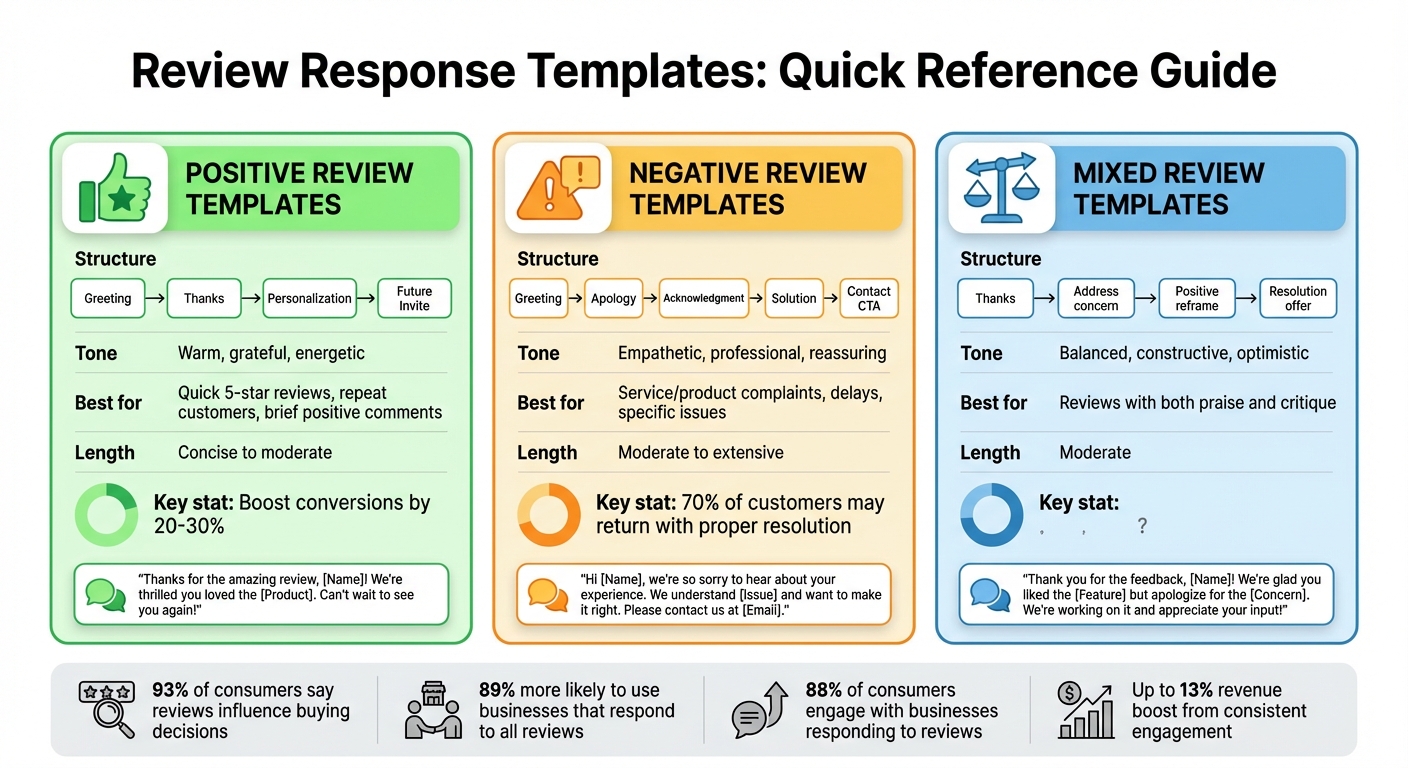
Review Response Templates Comparison Guide for SMBs
Efficiently managing reviews as an SMB often comes down to choosing the right response template. The table below breaks down the key features of positive, negative, and mixed review templates, helping you decide which approach best fits your needs.
Positive review templates focus on expressing gratitude, referencing specific feedback, and encouraging customers to return. Negative review templates prioritize an empathetic apology, acknowledgment of the issue, a proposed solution, and an invitation to continue the conversation offline. Mixed review templates strike a balance by thanking customers for their positive remarks before addressing any concerns and suggesting improvements.
Here’s a quick side-by-side comparison of these templates:
| Template Type | Structure | Tone | Best Use Cases | Length |
|---|---|---|---|---|
| Positive (e.g., Short Thank You) | Greeting + thanks + personalization + future invite | Warm, grateful, energetic | Quick 5-star reviews, repeat customers, brief positive comments | Concise to moderate |
| Negative (e.g., General Apology) | Greeting + apology + acknowledgment + solution offer + contact call-to-action | Empathetic, professional, reassuring | Service or product complaints, delays, specific issues | Moderate to extensive |
| Mixed (e.g., Thank and Address) | Thanks + address concern + positive reframe + resolution offer | Balanced, constructive, optimistic | Reviews containing both praise and critique | Moderate |
Studies show that detailed negative templates offering specific resolutions can encourage 70% of customers to return. Use this table to match your response style to the type of feedback you receive, ensuring every review is handled thoughtfully and effectively.
Responding to online reviews isn’t just a task – it’s a key part of shaping how U.S. consumers see your business. Studies show that businesses that consistently engage with reviews can see up to a 13% boost in revenue. When potential customers notice you addressing complaints with care and celebrating positive feedback, they’re far more likely to pick you over competitors who stay silent.
The templates shared earlier provide a practical system for tackling every type of review you might face. Whether it’s a quick thank-you for glowing five-star feedback, a thoughtful apology for a service hiccup, or a balanced response to mixed reviews, these examples help you respond efficiently while still keeping it personal. By including details like customer names or specific incidents, you can strike the perfect balance between saving time and sounding genuine. This approach lets you stand out without adding stress to your day.
Keep these templates handy in a central playbook that’s easy for your team to access. Assign someone to check reviews a few times each week during business hours, and aim to respond to negative feedback within 24 hours to limit any potential fallout. Adjust the tone of your responses to match your brand’s personality – whether that’s warm and friendly, professional, or even a bit playful.
Every review is an opportunity to make an impact. Businesses that actively respond to negative reviews often see improvements in their average star ratings – sometimes by as much as 0.2 stars. This small shift can turn critics into loyal advocates. To dive deeper into integrating review management with local SEO and digital marketing strategies, check out the resources available at Blue Aspen Marketing.
Whether the feedback is glowing, critical, or somewhere in between, each review gives you a chance to showcase what your business is all about. By using these strategies regularly, you’ll build a reputation that’s rooted in trust and community. Over time, this approach can lead to steady growth, stronger word-of-mouth referrals, and lasting relationships with customers in your local area.
Responding to reviews plays a major role in boosting your local SEO. When you actively engage with your customers, search engines take notice, as it reflects a sense of reliability and trust in your business.
Replying to both positive and negative reviews not only fosters interaction but also helps improve your visibility in local search rankings. Plus, crafting thoughtful responses shows potential customers that you genuinely care about their feedback, leaving a strong, positive impression of your business.
When addressing a negative review, maintaining professionalism and empathy is key. Begin by acknowledging the customer’s concern and thanking them for taking the time to share their feedback. Follow up with a genuine apology for their experience, making sure to address their specific issue directly. Provide a clear solution or outline the next steps to resolve the matter, and encourage them to reach out if further assistance is needed. This thoughtful response demonstrates your dedication to customer care and helps reinforce trust.
To craft professional and personalized responses to reviews, begin by addressing the reviewer by name and mentioning specific points from their feedback. For positive reviews, express sincere gratitude, while for negative ones, show empathy and a commitment to resolving their concerns. Maintain a tone that is respectful, friendly, and professional to reflect how much you value their input and care about their experience.


 Physical Therapy
 MedSpa
 Dental
 HVAC
HVAC Roofing
 Pest Control
 Cleaning Services
 Landscaping
 Hotel
Hotel Cruise
 Branding
 Content Marketing
 Email Marketing
 Graphic Design
 PPC (Online Ads)
 SEO (Search Engine Optimization)
 Website Design and Development
 Pest Control
 Plastic Surgeon
 Roofing