Want to stretch your marketing dollars while boosting returns? Here’s a quick guide to getting more out of your budget with proven strategies. From email marketing’s 3,600% ROI to PPC campaigns that deliver $8 for every $1 spent, small businesses can achieve big results by focusing on cost-effective channels.
Whether you’re investing in quick-win tactics like PPC or building long-term growth through SEO, these strategies can help you maximize ROI without overspending.
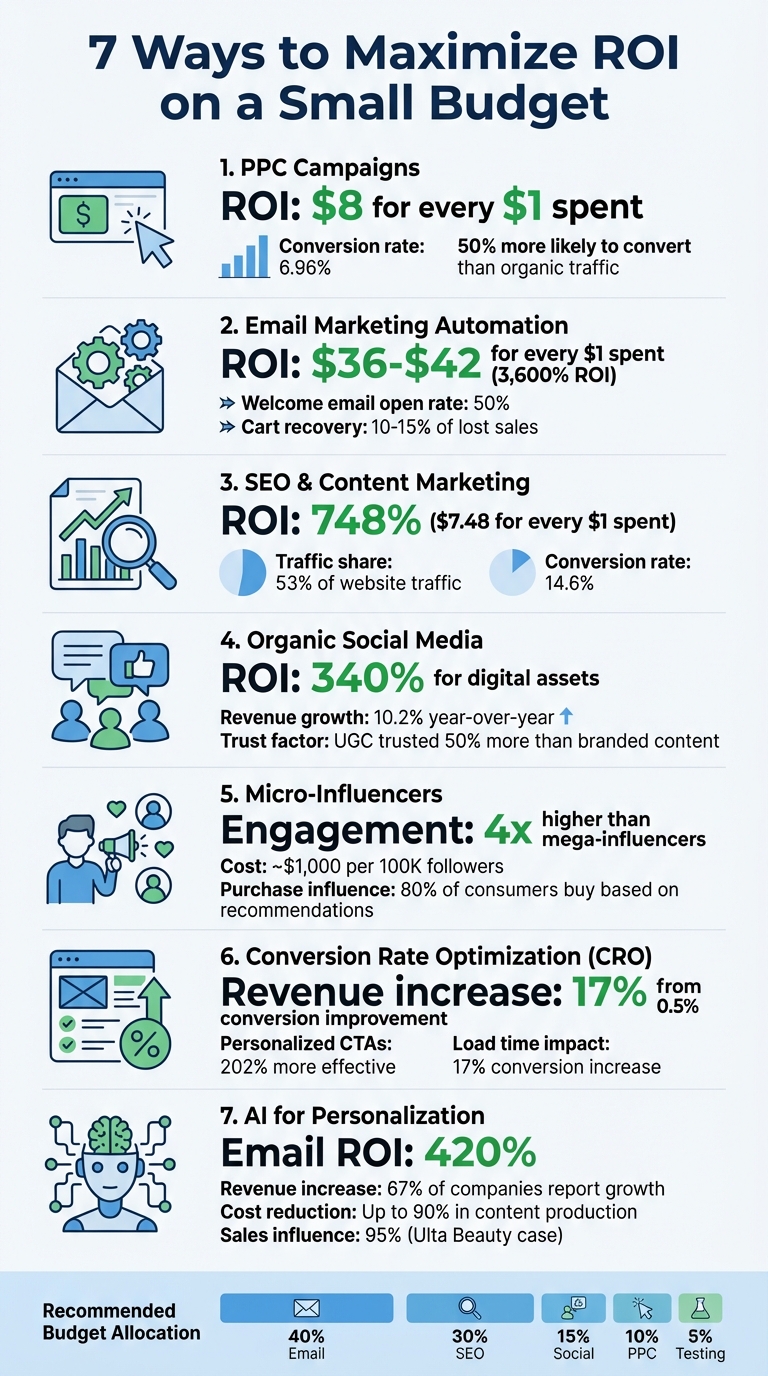
7 Marketing Strategies ROI Comparison for Small Businesses
When you’re working with a limited budget, every click needs to count. High-intent PPC campaigns are designed to target users who are ready to take action. Instead of bidding on broad, generic terms like "bakery", aim for more specific searches such as "order birthday cake online Houston." These long-tail keywords are not only more affordable due to lower competition but also tend to convert better because they align closely with what the searcher is looking for.
Long-tail keywords typically come with lower cost-per-click (CPC) rates compared to broad terms. For instance, a keyword like "buy lounge chair" averages around $1.11 per click, while broader terms can cost significantly more. To make your budget stretch even further, consider using negative keywords. By excluding terms like "free", "DIY", or "jobs", you can avoid paying for clicks from users who are unlikely to convert. Another effective tactic is geotargeting – if your business only serves customers within 20 miles, you can restrict your ads to that area and avoid wasting money on irrelevant clicks. These strategies ensure that every dollar is spent reaching high-value prospects, which directly supports your return on investment (ROI) goals.
The numbers back up the value of PPC campaigns. On average, Google Ads delivers $8 in revenue for every $1 spent. Additionally, PPC traffic is 50% more likely to convert than organic traffic. With an average conversion rate of 6.96% across Google Ads, even small campaigns can generate meaningful results. This makes PPC an effective option for businesses looking to see measurable returns quickly.
Running successful PPC campaigns doesn’t require advanced technical skills. Tools like Google’s Smart Bidding and Responsive Search Ads use automation to optimize your campaigns, so you don’t have to make constant manual adjustments. Start small by promoting a single product or service instead of trying to advertise your entire catalog. Features like ad extensions – such as sitelinks and callouts – can also increase your ad’s visibility. Another key tip: ensure your landing page headline matches your ad copy. This can improve your Quality Score and boost conversion rates.
At Blue Aspen Marketing, we specialize in crafting high-intent PPC strategies that deliver measurable growth. By ensuring every ad dollar is spent wisely, we help clients achieve immediate results while laying the groundwork for future success.
PPC campaigns provide instant results – you can start driving traffic and generating sales within hours of launching an ad. It’s perfect for quick wins. However, think of PPC as "renting attention"; once you stop paying, the traffic disappears. That’s why the most successful small businesses combine PPC with longer-term strategies like SEO. Paid ads can generate immediate cash flow while you work on building an organic presence that will pay off over time.
Email marketing automation is a game-changer for boosting ROI with minimal daily effort. Unlike paid ads that stop delivering results when you stop spending, automated email sequences keep working in the background – welcoming new subscribers, recovering abandoned carts, and nurturing leads consistently.
Email marketing is one of the most budget-friendly tools available. Many platforms offer free plans for smaller lists (up to 500–2,000 subscribers), while paid plans typically range from $13 to $50 per month. To put it into perspective, direct mail campaigns can cost up to 100 times more than email marketing. On top of that, small business owners report saving 5–10 hours per week by automating tasks like welcome emails and order confirmations.
The numbers speak for themselves: email marketing delivers an average return of $36 to $42 for every $1 spent. That makes it one of the most profitable channels in digital marketing. Automated welcome emails, for example, boast an impressive open rate of 50%, far outpacing the 15–25% open rate of standard promotional emails. And don’t overlook abandoned cart reminders – they can recover 10–15% of lost sales, converting casual browsers into paying customers without the need for extra advertising spend.
Getting started with email automation doesn’t require technical skills or a design background. Most modern email platforms offer drag-and-drop editors and pre-built templates that make setting up workflows – like welcome sequences or cart recovery emails – quick and easy. To grow your email list, try offering a simple incentive, such as a 10% discount code or a free guide. Once you have subscribers, segment your audience by purchase history or interests to keep your content relevant and engaging. This approach not only complements earlier PPC efforts but also establishes a direct and ongoing connection with your customers.
Email automation delivers benefits both immediately and over time. In the short term, you can expect quick wins, such as recovering abandoned carts and speeding up customer responses. Over the long term, you’re building stronger relationships with your audience, increasing customer lifetime value in the process. With email marketing, you gain direct access to your customers’ inboxes, and as your subscriber list grows, automation scales effortlessly.
At Blue Aspen Marketing, we specialize in helping businesses create email automation strategies that drive immediate results while fostering lasting customer loyalty. Each message is an opportunity to strengthen relationships and generate measurable revenue, ensuring your efforts pay off both now and in the future.
SEO and content marketing work hand in hand, creating a reliable and cost-efficient strategy for long-term growth. Unlike paid ads, which stop generating results the moment you stop funding them, organic search continues to deliver traffic and leads well after content is published. Paid advertising might give you a quick visibility boost, but SEO lays the groundwork for lasting online presence. Over time, this foundation strengthens, offering consistent growth without the need for constant spending. This enduring visibility not only outlasts paid campaigns but also provides a cost-effective path to sustainable success.
Starting with SEO doesn’t have to break the bank. Free tools like Google Business Profile, Keyword Planner, Analytics, and Search Console are powerful resources to get you started. For small businesses, SEO investments often range from $750 to $2,000 per month, but meaningful results can still be achieved on a smaller budget by focusing on the essentials. Begin by addressing broken links and improving page speed, then claim and optimize your Google Business Profile. With 46% of Google searches having local intent, and 72% of local searchers visiting a store within five miles, these simple steps can provide quick, cost-free visibility.
The numbers speak for themselves: SEO delivers an impressive 748% ROI, meaning $7.48 for every dollar spent, while driving 53% of website traffic and boosting revenue. Blogging alone can increase inbound links by 97%, and SEO-driven traffic converts at a solid 14.6% rate. A great example is Sugar Geek Show, a cake-decorating platform that grew its organic traffic to over 300,000 monthly visitors by focusing on SEO. Today, their blog accounts for 60% of the company’s total revenue.
Small businesses can gain traction by creating content that directly addresses their customers’ questions. Use Google’s "People Also Ask" section to uncover what your audience is searching for, then craft content that’s conversational and problem-solving rather than overly focused on keywords. Maximize your efforts by repurposing this content into formats like social media posts, email newsletters, infographics, or short videos. This approach ensures you get the most out of every piece without stretching your resources.
SEO is a long-term strategy, often taking at least six months to deliver noticeable results. But the payoff is worth the wait. In the meantime, focus on quick wins like optimizing your Google Business Profile or refreshing older blog posts with updated information. Revamping existing content can often restore lost rankings with less effort than creating something entirely new. Over time, SEO builds steady traffic and solidifies your authority in your industry. This long-lasting foundation enhances your broader marketing efforts, supporting everything from PPC campaigns to email automation. At Blue Aspen Marketing, we specialize in crafting SEO and content strategies that deliver both immediate results and sustainable growth, seamlessly integrating with other high-intent marketing channels.
You don’t need a hefty budget to make organic social media work for your business. In fact, these strategies can complement other affordable marketing efforts, ensuring every dollar you spend delivers real results. The trick? Work smarter by repurposing existing content and leveraging user-generated content (UGC). For example, transform high-performing blog posts, podcasts, or customer testimonials into engaging social media updates. UGC, like customer photos or reviews, is a goldmine – it’s trusted 50% more than traditional branded posts and costs you nothing to produce. Just reshare what your customers are already creating to build trust and authenticity.
The primary resource you’ll invest in organic social is time, not money. Beyond crafting content, outbound engagement – commenting on posts from other creators or businesses – can boost your visibility with their audiences at zero cost. Instead of spreading yourself too thin, focus on the platforms where your audience is most active. This approach not only saves money but also sets the stage for long-term, scalable growth.
Organic social strategies can deliver impressive returns. For instance, digital assets often generate a 340% ROI, meaning $340 for every $100 spent. Brands that prioritize organic strategies see average year-over-year revenue growth of 10.2%. Calculating ROI is simple: (Total Revenue – Total Investment) / Total Investment x 100. When evaluating organic efforts, factor in labor costs, content production, and any tools you use. A 5:1 ROI ratio (earning $5 for every $1 spent) is strong, while 10:1 is exceptional. To understand what’s working, track UTM parameters on your social links to pinpoint which posts are driving traffic and conversions.
Even with limited resources, small businesses can thrive using organic social strategies. For example, take one high-performing piece of content and turn it into multiple social graphics or short videos. This simple step can increase the value of your original asset by up to 300%. Encourage employees to share updates on their personal networks, expanding your reach beyond corporate accounts. Dive into niche communities on platforms like Reddit, LinkedIn groups, or Facebook to connect with your target audience without spending on ads. A great case study? Between 2008 and 2010, Dropbox grew its user base by an astounding 3,900% in just 15 months with a referral program that rewarded both the inviter and invitee with free cloud storage. These tactics not only cut costs but also create a solid foundation for long-term customer engagement.
Organic social media is a long game. While paid ads can deliver quick results, organic strategies shine over time by reducing customer acquisition costs and building consistent brand awareness.
“Brands that are crushing organic marketing tend to do much better on the paid marketing front because they aren’t ‘creating ads’ – they’re creating posts that consumers organically engage with and then throwing gasoline on the fire with their paid marketing efforts”.
If you’re already experimenting with organic social strategies, adding micro-influencer marketing to the mix can be a smart way to connect with audiences without breaking the bank.
Micro-influencers – those with follower counts between 10,000 and 100,000 – strike a great balance between reach and relatability. Unlike mega-influencers, who might charge $50,000 or more for a single post, micro-influencers are far more affordable, typically charging around $1,000 for every 100,000 followers. Even nano-influencers (1,000–10,000 followers) are an option, often charging just $50–$200 per post or working in exchange for free products. This makes influencer marketing a viable option for businesses with limited budgets.
The real magic of micro-influencers isn’t just in their lower fees – it’s in their ability to drive engagement. On average, micro-influencers generate over four times the engagement of larger influencers. For comparison, mega-influencers with over a million followers often see engagement rates drop below 1%. Plus, micro-influencers usually create their own content, saving you the cost of professional photo or video shoots.
Start by looking at your current customers. Those who already tag your brand or leave glowing reviews can be ideal partners – they’re familiar with your product and bring credibility to their endorsements.
The numbers don’t lie: over 80% of consumers say they’ve purchased something based on an influencer’s recommendation. With 78% of internet users using social media to discover new products, the potential for conversions is huge. To measure success, use tools like unique promo codes or affiliate links. You can also request performance reports a week after a post goes live to get the full picture of impressions. For Instagram Stories, UTM parameters are a must since clickable links aren’t supported in regular grid posts.
You don’t need fancy tools to find the right micro-influencers. Search relevant hashtags in your industry, keep an eye on who your competitors are working with, and use social listening tools to spot creators talking about your product category. Instead of focusing solely on follower count, prioritize engagement rates and audience demographics.
Once you’ve partnered with an influencer, maximize your investment by repurposing their best-performing content across your own platforms. Let them keep their authentic voice – overly scripted posts often feel disingenuous and won’t resonate with their audience.
This approach, like others we’ve discussed, focuses on using targeted, budget-friendly strategies to ensure every dollar you spend delivers measurable results.
When you’re working with a limited budget, it makes sense to focus on getting more out of the traffic you already have instead of constantly spending to attract new visitors. That’s the essence of conversion rate optimization (CRO) – making your website more effective at turning visitors into customers. Below, we’ll explore how small, cost-effective changes can lead to big results.
You don’t need a hefty budget to see meaningful improvements with CRO. A great example? Back in 2011, Expedia boosted its annual profits by $12 million just by removing one unnecessary field from its checkout form. More recently, in early 2025, the travel company Going saw a 104% month-over-month jump in its homepage conversion rate simply by tweaking the text on its primary call-to-action.
To prioritize changes, try using the PIE Framework, which evaluates Potential, Importance, and Ease. Free tools like Google Analytics and Hotjar (which has a free tier) can help you analyze how users interact with your site and identify problem areas where visitors drop off.
Even small tweaks can produce impressive financial gains. For instance, increasing your conversion rate from 3% to 3.5% – just a half-percent jump – can result in a nearly 17% revenue boost. Spotify saw a 24% increase in subscription conversions through targeted A/B testing and user experience updates, while Quip improved its product pages and achieved a 4.7% lift in order conversions.
Other simple adjustments can also deliver big returns. Reducing page load times by just a few seconds can increase conversion rates by 17%. Adding testimonials can drive a 34% lift in conversions, and personalized calls-to-action are 202% more effective than generic ones. These examples show that small, thoughtful changes can have a major impact.
You don’t need a full development team to start improving your conversion rates. Begin by focusing on the basics. Make sure your unique value proposition and main call-to-action are prominently displayed above the fold – users shouldn’t have to scroll to see them [56,57]. Simplify your forms, as 27% of users abandon forms that are too long. Adding trust elements like customer reviews, security badges, or media logos can also build credibility without breaking the bank [55,56].
Other easy-to-implement ideas include using exit-intent popups to offer last-minute incentives and testing small changes, like button colors or headlines, to see what resonates most with your audience [55,56]. Even adding a simple quiz to guide shoppers to the right product can boost their confidence and your sales.
CRO offers a mix of quick wins and lasting benefits. Immediate changes, like updating a call-to-action or adding a popup, can provide fast results. Meanwhile, long-term improvements, such as creating a more user-friendly site, can lower customer acquisition costs and increase customer lifetime value by delivering a better overall experience. With customer acquisition costs rising, optimizing the traffic you already have is one of the smartest ways to maximize your budget.
"Conversion rate optimization (CRO) is arguably your most important marketing task. It’ll help you maximize returns on your marketing campaigns, enhance the customer experience, grow lifetime value, and ultimately ensure the long-term sustainability of your business."
- Angela Rollins, Author, WordStream
AI tools have become more accessible than ever, allowing small businesses to achieve impressive results without breaking the bank. The trick is to start small, focusing on areas where AI can make the biggest difference. This approach not only simplifies adoption but also helps you measure the financial benefits of AI more effectively.
Getting started with AI doesn’t require a huge budget. For instance, ChatGPT Plus costs just $20 per month and can assist with tasks like content brainstorming and data analysis. Free tools such as Google Analytics already feature predictive audiences, which can identify users likely to make a purchase or leave. And if you’re looking for 24/7 customer support, HubSpot‘s Free AI Chatbot Builder offers an easy, no-code solution for qualifying leads around the clock.
The real savings come from automation. AI-powered tools for design and content creation can reduce production costs by up to 90%. Smaller brands in particular are taking advantage of this, as they are 6x more likely than larger brands to invest in personalization, seeing it as a smart way to win customer loyalty.
AI’s impact on revenue is undeniable. 67% of companies using AI in marketing and sales reported an increase in revenue within a year. In specific areas, AI has delivered a 420% ROI in email marketing and a 340% ROI in digital assets by automating tasks like audience segmentation and optimizing delivery times.
Some companies have seen dramatic results. During the pandemic, Les Mills used Google’s AI-powered Demand Gen campaigns to achieve 561% more sign-ups at 72% lower costs in just four weeks. Vans, a popular footwear brand, adopted Performance Max during the holiday season and saw a 46% jump in conversions and an 86% sales increase compared to their previous strategy. Meanwhile, Ulta Beauty leveraged AI-driven personalization with SAS Customer Intelligence 360, resulting in 95% of their total sales being influenced by personalized marketing.
AI tools like next-best-experience engines can also boost revenue by 5%-8% while improving customer satisfaction by 15%-20%. With over 70% of consumers expecting personalized interactions – and 76% feeling frustrated by generic messaging – AI helps meet these expectations efficiently, even for small teams. By combining AI with customer data, small businesses can refine personalization and analytics, driving even higher returns on their efforts.
Modern AI tools are designed to be user-friendly, making them accessible even for small businesses. Start with a single campaign, using clean and reliable customer data, before scaling your efforts. For instance, AI can optimize email send times for individual recipients, ensuring messages land when they’re most likely to engage. AI can also repurpose existing content, resizing and reformatting it for different platforms, which can increase the value of your assets by 300% .
However, the quality of your data is crucial. Inaccurate or incomplete data will lead to poor AI performance, no matter how advanced the tool is. Look for AI solutions that integrate directly with your CRM, allowing marketing and sales teams to share data seamlessly for better audience targeting.
"AI delivers the biggest impact when it connects directly to your CRM and workflows. With shared data, every campaign becomes measurable, trackable, and tied to real business outcomes."
- Chaviva Gordon-Bennett, Content Strategist, monday.com
These simple steps can set the stage for AI to become a core part of your long-term marketing strategy.
AI offers both immediate and lasting benefits. Short-term wins, like email optimization or ad targeting, can show results in as little as 2-4 weeks. Over time, as AI tools process more data, they become increasingly effective, helping you move from guesswork to precise, data-driven decisions.
In the short term, AI can automate 30% of routine, data-heavy marketing tasks, freeing your team to focus on strategy and creativity. By identifying customers who are "at risk of churning" or "likely to make a purchase this week", businesses can enhance customer lifetime value through targeted retention efforts . Marketers leveraging first-party data with AI have reported a 30% boost in performance compared to those who don’t.
AI’s ability to balance quick wins with long-term growth makes it an invaluable tool for businesses looking to stay competitive in a rapidly evolving market.
Maximizing ROI on a tight budget requires a smart mix of paid and organic marketing strategies. By combining the quick results of PPC, the steady growth of SEO, and the high return of email marketing, small businesses can create a well-rounded plan that delivers both immediate results and long-term benefits.
The key is finding the right balance. PPC can drive instant traffic and help test messaging, while SEO works in the background to build authority and organic reach over time. Email marketing ties it all together, converting traffic into loyal customers through automation and well-designed landing pages. Together, these tactics create a system that works efficiently without overspending.
For a practical breakdown, consider this budget allocation: 40% for email marketing and list building, 30% for SEO and content creation, 10% for PPC retargeting, 15% for social media efforts, and 5% for experimenting with new ideas. This approach ensures you’re investing in assets that grow over time while also seizing immediate opportunities.
Focus on one or two channels where your target audience is most active. Once you’ve mastered those, you can expand your efforts. Success in digital marketing isn’t about spending more – it’s about making smarter choices.
PPC advertising offers small businesses a practical way to achieve measurable results, even with tight budgets. Start by defining a clear objective – whether it’s generating leads or increasing local sales – and set a daily budget you can stick to. For example, a $2,000 monthly budget breaks down to roughly $66 per day. To make your dollars count, focus on long-tail keywords that show high intent but face less competition. Using exact-match bids can further improve relevance and help keep costs down.
Stretch your budget further by leveraging geo-targeting to connect with local customers, scheduling ads during peak hours, and taking advantage of promotional ad credits (like those often offered by Google Ads). Keep a close eye on your campaign’s performance metrics, such as click-through rates and conversions. If certain ads aren’t delivering, pause them and shift those funds to the ones that are driving results. For additional support, Blue Aspen Marketing can help fine-tune these strategies, ensuring every dollar you spend works harder to deliver a strong return on investment.
Email marketing automation offers small businesses an effective way to maximize their marketing efforts without stretching their budget. By streamlining tasks like scheduling and delivering personalized, targeted campaigns, it frees up time while maintaining consistent communication with both leads and customers.
The benefits go beyond saving time – it’s also a revenue driver. For every $1 spent on email marketing, businesses typically see returns exceeding $40, with ROI percentages often surpassing an astounding 4,200%. It’s a smart, budget-friendly strategy to enhance engagement and grow revenue.
Partnering with micro-influencers can often provide a stronger return on investment (ROI) compared to traditional advertising methods. Influencers with fewer than 100,000 followers are often perceived as more genuine, which tends to drive higher engagement and better conversion rates. Plus, this approach is usually more budget-friendly, making it a smart choice for small businesses working with limited resources.
While traditional advertising methods like TV or print ads can reach a broader audience, they often come with hefty price tags and may not foster the same level of trust or interaction. Micro-influencers, however, enable businesses to connect with highly targeted niche communities. Even better, their performance can be tracked in real-time through metrics such as likes, comments, and clicks. This allows for quick adjustments to campaigns, helping businesses fine-tune their strategy and get the most out of their investment.
For small businesses, collaborating with micro-influencers offers a flexible and measurable way to meet marketing goals without breaking the bank. Companies like Blue Aspen Marketing specialize in crafting and managing these partnerships, ensuring a data-driven approach that aligns with your budget and objectives.


 Physical Therapy
 MedSpa
 Dental
 HVAC
HVAC Roofing
 Pest Control
 Cleaning Services
 Landscaping
 Hotel
Hotel Cruise
 Branding
 Content Marketing
 Email Marketing
 Graphic Design
 PPC (Online Ads)
 SEO (Search Engine Optimization)
 Website Design and Development
 Pest Control
 Plastic Surgeon
 Roofing