AI-powered search tools are changing how people find pest control services. To stay competitive in 2026, pest control businesses need to focus on local SEO, voice search, and AI-generated results. Here’s what you need to know:
These strategies ensure your pest control business stays visible and relevant in a rapidly evolving digital landscape.
2026 SEO Statistics for Pest Control Businesses
Your Google Business Profile plays a major role in local SEO and determining your placement in the Google Map Pack. Google evaluates three main factors for Map Pack rankings: Relevance (how well your business matches the search query), Distance (proximity to the searcher), and Prominence (how established or recognized your business is). For searches like "termite inspection near me" or "emergency exterminator", being in the top three results is essential.
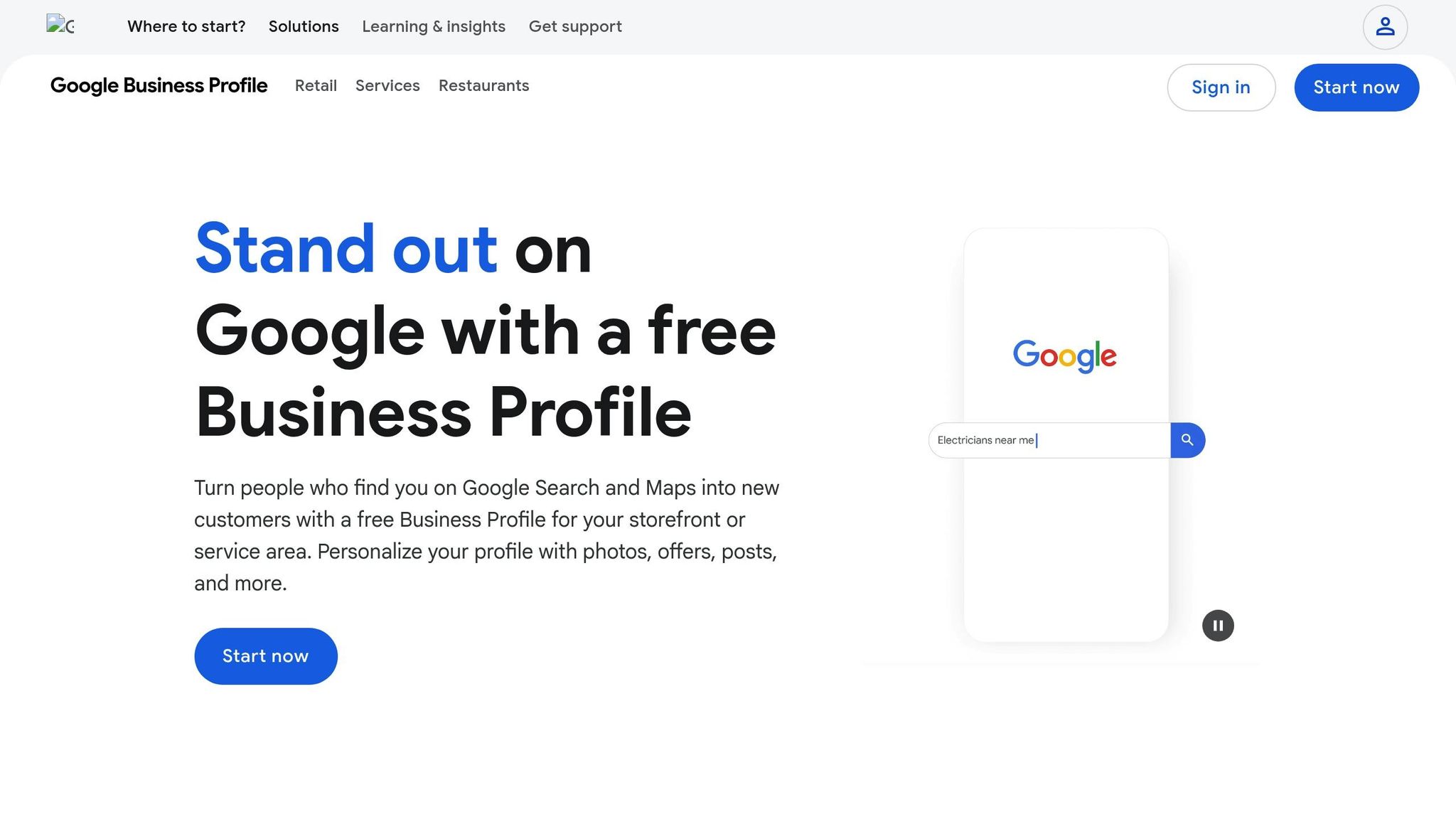
Think of your Google Business Profile as an extension of your website. By 2026, these profiles have evolved into robust microsites, offering functionality that rivals standalone websites. To make the most of your profile, fill out every field completely – business hours, service areas, phone number, website, and a detailed list of services. Google often pulls keywords directly from your profile, so if you offer services like "bed bug treatment" or "commercial rodent control", include those exact terms in your business description and service list.
Take your profile to the next level by adding high-quality photos of your team, service vehicles, and completed projects. Regular updates – such as seasonal promotions, recent work, or new services – signal to Google that your business is active and engaged. Lastly, ensure your NAP (Name, Address, Phone) is consistent across all platforms to reinforce your local SEO signals.
Your NAP (Name, Address, Phone) must be consistent everywhere online. Variations in business information – like listing "123 Main Street" on your Google profile but "123 Main St." on another directory – can confuse search algorithms and weaken your authority signals.
To avoid this, use your exact legal business name, stick to one address format, and ensure the same primary phone number is listed across all platforms. Prioritize consistency on major citation platforms such as Data Axle, Localeze, Yelp, Apple Maps, Bing Places, and industry-specific directories like Angie’s List or HomeAdvisor. Conduct quarterly audits to catch and fix inconsistencies before they impact your visibility. Once your listings are aligned, focus on gathering online reviews to further strengthen your profile’s credibility.
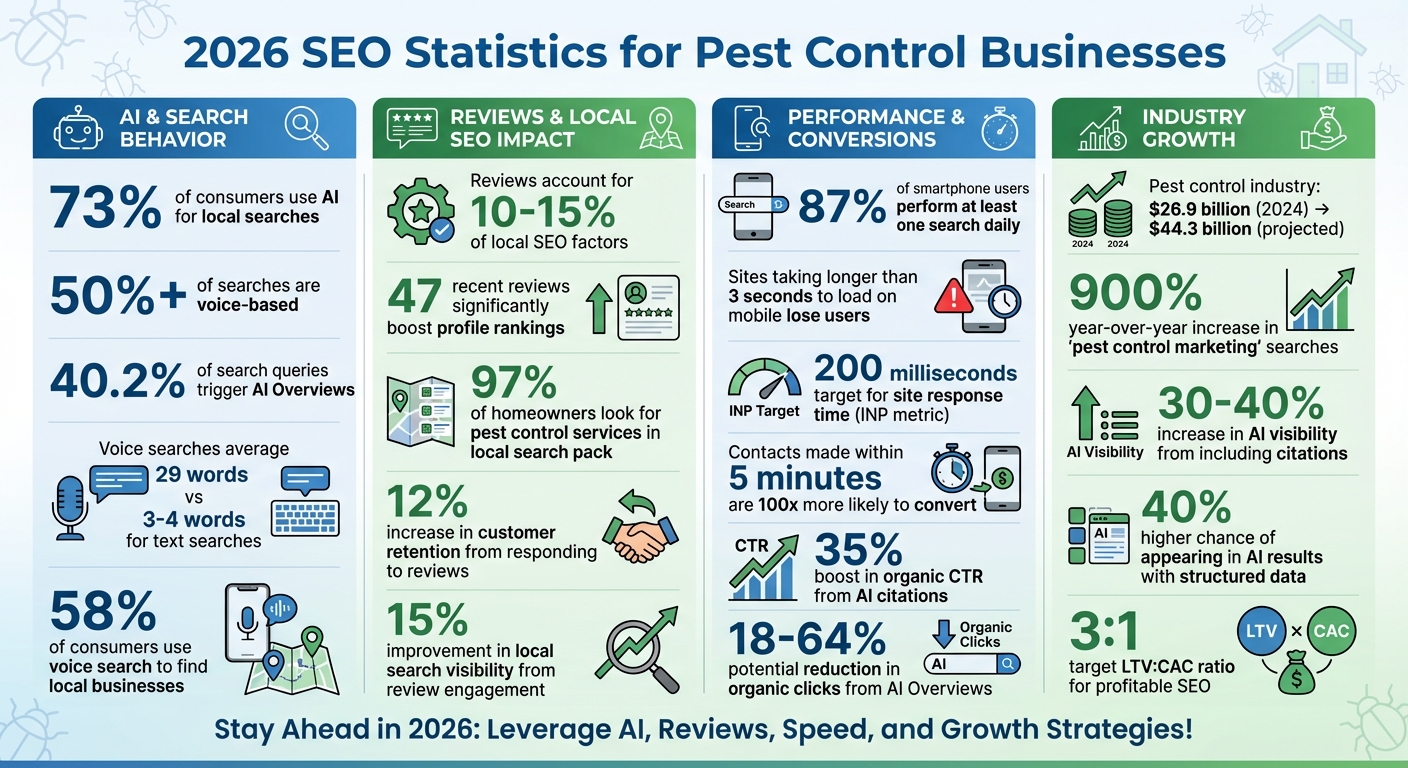
By 2026, online reviews have become critical trust signals, with your Google Business Profile’s review score and volume directly influencing your rankings. Reviews now account for 10–15% of local SEO factors, and having around 47 recent reviews can significantly boost your profile. Fresh reviews are especially important, as they show that your business is active. Additionally, when customers mention specific services – like "termite inspection" or "wasp nest removal" – it can further improve your rankings.
Engage with every review, regardless of whether it’s positive or negative. Responding to reviews not only demonstrates attentiveness but can also increase customer retention by 12% and improve your local search visibility by 15%. These efforts help solidify your business’s reputation with both search engines and potential customers, enhancing your overall local presence.
As local SEO strategies evolve, new search technologies are changing how pest control businesses approach online visibility. Instead of typing straightforward keywords like "termite exterminator Chicago", customers now ask conversational questions such as, "Who’s the best termite company near me?" By 2026, voice search is expected to account for more than 50% of all searches, and tools like Google’s AI Overviews are transforming how results are displayed. SEO today isn’t just about driving clicks – it’s about becoming a trusted source in AI-generated answers.
AI-driven search engines analyze every detail about your business online. To secure a spot in AI-generated answers, it’s essential to maintain consistent business information across platforms, implement clear schema markup, regularly publish updated content, and engage with your community. Schema markup plays a critical role in helping AI understand your services, the areas you serve, and the questions you address. As GMB Briefcase emphasizes:
"Schema markup is no longer optional – it’s essential for helping AI understand the context of your content."
This groundwork lays the path for optimizing your content specifically for voice search.
Voice searches tend to be longer and more conversational than traditional text queries. While text searches typically average 3-4 words, voice searches often include up to 29 words. For example, instead of searching "bed bug treatment", customers might ask, "How do I know if I have bed bugs in my apartment?" or "What’s the fastest way to get rid of ants in my kitchen?"
To capture these queries, build content around natural language questions. Use straightforward headings that mimic how people talk, and provide direct answers in the first sentence or two. Voice assistants often pull information from featured snippets and your Google Business Profile, so optimizing these with accurate, location-specific details is critical. With 58% of consumers using voice search to find local businesses, this strategy is no longer a nice-to-have – it’s how your audience finds you. Strengthen these voice-optimized pages with detailed structured data.
Structured data acts as a bridge between your website and AI systems. Start by adding Local Business Schema to your homepage to highlight your location, operating hours, and business type. For service pages, include FAQPage schema to address common questions like "How much does termite treatment cost?" or "Do you offer same-day service?"
Defining your service areas is just as important. Create dedicated landing pages for each city or ZIP code you serve, and weave local keywords into headings, content, and meta tags. This approach helps Google treat each service area as a unique entity, increasing your chances of appearing in the local search pack, where 97% of homeowners look for pest control services.
Once you’ve strengthened your local presence and polished your technical SEO, the next step is creating content that establishes your authority. This means crafting materials that clearly showcase your expertise. For instance, searches for "pest control marketing" have skyrocketed by 900% year-over-year, with AI citations boosting organic click-through rates by 35%. With 40.2% of search queries now triggering AI Overviews, your content must deliver expert-level insights and address specific problems to stand out. This strategy works hand-in-hand with the local and technical SEO efforts you’ve already implemented.
Pests don’t follow a one-size-fits-all pattern – they show up based on the season and location. For example, a termite problem in the humid climate of Birmingham, Alabama, is vastly different from a rodent infestation in snowy Boston. To connect with your audience, focus on local pest data, seasonal trends, and climate-specific solutions. Regularly updating your site with local pest insights not only keeps your content fresh but also signals to search engines that you’re actively engaged with the community. Adding local references – like landmarks, neighborhood names, or weather details – makes your content more relevant and valuable to your service area.
The needs of homeowners and business owners vary greatly, and your content should reflect that. A restaurant manager searching for "commercial pest management" is likely concerned with health code compliance and scheduling treatments that won’t disrupt operations. On the other hand, a homeowner looking up "how to get rid of ants in my house" is focused on quick fixes and family-safe solutions. Tailored content can make all the difference. For example, one pest control company saw improved rankings by creating distinct content for residential and commercial audiences. Their "About Us" page emphasized "50+ years of expert pest control solutions", which helped build trust. To further engage these audiences, share industry insights on LinkedIn for commercial clients and use platforms like Facebook and Instagram to post residential tips and before-and-after photos.
To establish what search engines call "topical authority", it’s essential to integrate service pages, location pages, and educational content. Start with educational pillar pages addressing broad topics, such as "How to identify bed bugs." Then, link these to specific service pages like "Bed Bug Treatment in [City Name]" and location pages for each ZIP code you cover. For example, one company created dedicated pages for each service area, strengthening their internal link structure. Enhance this strategy by adding LocalBusiness schema to location pages and FAQ schema to educational content. Structured data increases the chances of appearing in AI summary results by up to 40%. Additionally, including citations and statistics in your content can boost AI visibility by 30-40%.
Your content and local visibility won’t matter if your website is sluggish. For 2026, Core Web Vitals have shifted, with Interaction to Next Paint (INP) now taking over from First Input Delay as the main metric for gauging how quickly your site reacts to user actions. If your site takes longer than 3 seconds to load on mobile, users are likely to leave, which can hurt both engagement and rankings. A slow-loading site doesn’t just frustrate visitors – it directly impacts your search engine rankings and conversion rates. These technical updates are crucial for delivering a smooth mobile experience, forming the foundation of the performance metrics discussed below.
To meet the updated Core Web Vitals 2.0 standards, focus on optimizing your site’s speed and responsiveness. Here’s how:
Your site should respond to user actions – like clicks or taps – within 200 milliseconds to avoid lag. Also, reserve space for dynamic elements to prevent layout shifts that disrupt the user experience. Tools like Google’s PageSpeed Insights, the Chrome User Experience Report, and the Core Web Vitals report in Google Search Console can help you monitor and improve performance. As WolfPack notes:
"A slow website hurts rankings, user experience, and conversion rates. Delaying performance improvements can add months to your SEO timeline".
With mobile-first indexing now the standard, your website must adapt seamlessly to all screen sizes. Features like intuitive navigation menus, clickable phone numbers, and streamlined contact forms are essential – especially for urgent searches. For pest control businesses, this is critical: 87% of smartphone users perform at least one search daily, and many are looking for emergency services on their phones. A mobile-friendly design not only enhances usability but also drives quicker conversions for those "need-it-now" moments.
Make sure buttons and links are spaced appropriately for easy tapping, and steer clear of intrusive pop-ups that obscure content. Test your mobile site on actual devices – not just desktop simulators – to ensure it’s fast, functional, and offers the same content as your desktop version.
To measure your local SEO success, keep an eye on these key metrics:
Additionally, monitor your LTV:CAC ratio (Lifetime Value to Customer Acquisition Cost), aiming for a 3:1 ratio or higher to ensure your SEO efforts are yielding long-term profitability. With AI Overviews now featured in 40.2% of search queries – potentially reducing organic clicks by 18–64% – track not just clicks but also mentions and citations in AI-generated results. Use tools like Google Analytics and Search Console to evaluate landing page performance and Core Web Vitals metrics. These insights tie directly to how your technical SEO efforts enhance local visibility and attract qualified leads.
The world of SEO is shifting rapidly, and pest control businesses need to keep pace. With AI reshaping the focus from simple clicks to becoming a trusted source in AI-generated answers, the importance of E-E-A-T (Experience, Expertise, Authoritativeness, and Trustworthiness) has grown significantly. Notably, Experience now plays a key role in standing out against generic AI-driven content.
As the pest control industry expands – from $26.9 billion in 2024 to an estimated $44.3 billion – rising customer acquisition costs make it more important than ever to refine your SEO strategy. Local search remains a powerful driver of click-through rates and conversions, underscoring the need for effective, localized SEO to fuel sustainable growth.
By implementing the strategies outlined in this article, you can strengthen your online presence, attract highly qualified leads, and manage costs more effectively. Focusing on local SEO, technical excellence, and content that builds authority ensures your business is well-positioned for long-term success. From improving Core Web Vitals and mobile site performance to optimizing for voice search and creating authoritative content, these techniques provide a roadmap for navigating the evolving SEO landscape.
Blue Aspen Marketing specializes in bringing these strategies to life for pest control businesses. Whether it’s optimizing your Google Business Profile, creating mobile-friendly websites, or building content that establishes your authority, Blue Aspen Marketing delivers tailored SEO solutions that help you adapt to change and achieve measurable growth.
To stay ahead in optimizing for voice search in 2026, pest control businesses should zero in on natural, question-based keywords. These mimic the way people phrase their queries when speaking. Incorporate these into your site’s content, FAQ pages, and blog posts to better align with voice search patterns.
Another crucial step is using structured data markup. This helps search engines interpret your content more effectively, increasing your chances of being featured in voice search results. Don’t forget to focus on local SEO – optimize your Google Business Profile and weave location-specific keywords into your content to attract nearby customers. Lastly, make sure your website is mobile-friendly and quick to load, as mobile devices dominate voice search usage.
Online reviews are a game-changer when it comes to boosting local SEO for pest control businesses. They not only enhance your credibility but also improve your visibility in local search results, which can directly impact how search engines rank your business.
When customers leave positive reviews, it builds trust with potential clients and sends a strong message to search engines that your business is dependable and relevant. By actively encouraging happy customers to share their experiences on platforms like Google, you can attract more inquiries and maintain a competitive edge in your local market.
Consistency in your business information plays a key role in AI-driven search results. When details like your business name, address, and phone number are uniform across all platforms, search engines and AI systems can accurately identify and trust your business. This not only boosts your visibility in local searches but also strengthens your credibility with both users and search algorithms.
On the flip side, inconsistent information can throw AI systems off track. It might lead to lower search rankings or even incorrect listings, which can hurt your business. Keeping your information accurate ensures you show up in the right local searches and makes it easier for potential customers to find and trust you.


 Physical Therapy
 MedSpa
 Dental
 HVAC
HVAC Roofing
 Pest Control
 Cleaning Services
 Landscaping
 Hotel
Hotel Cruise
 Branding
 Content Marketing
 Email Marketing
 Graphic Design
 PPC (Online Ads)
 SEO (Search Engine Optimization)
 Website Design and Development
 Pest Control
 Plastic Surgeon
 Roofing