If your roofing business isn’t ranking on Google’s first page, you’re losing leads. In 2026, local SEO and AI-driven strategies are essential for roofing companies to compete in a crowded market. With nearly 7.4 million monthly searches for roofing services and 99% of consumers turning to the internet to find local businesses, your online presence is your biggest revenue driver.
Here’s what matters most:
With AI shaping search behavior, SEO is no longer just about keywords – it’s about aligning your content with how search engines and homeowners think. Stay ahead by auditing your strategies regularly and focusing on high-intent leads that convert into jobs.
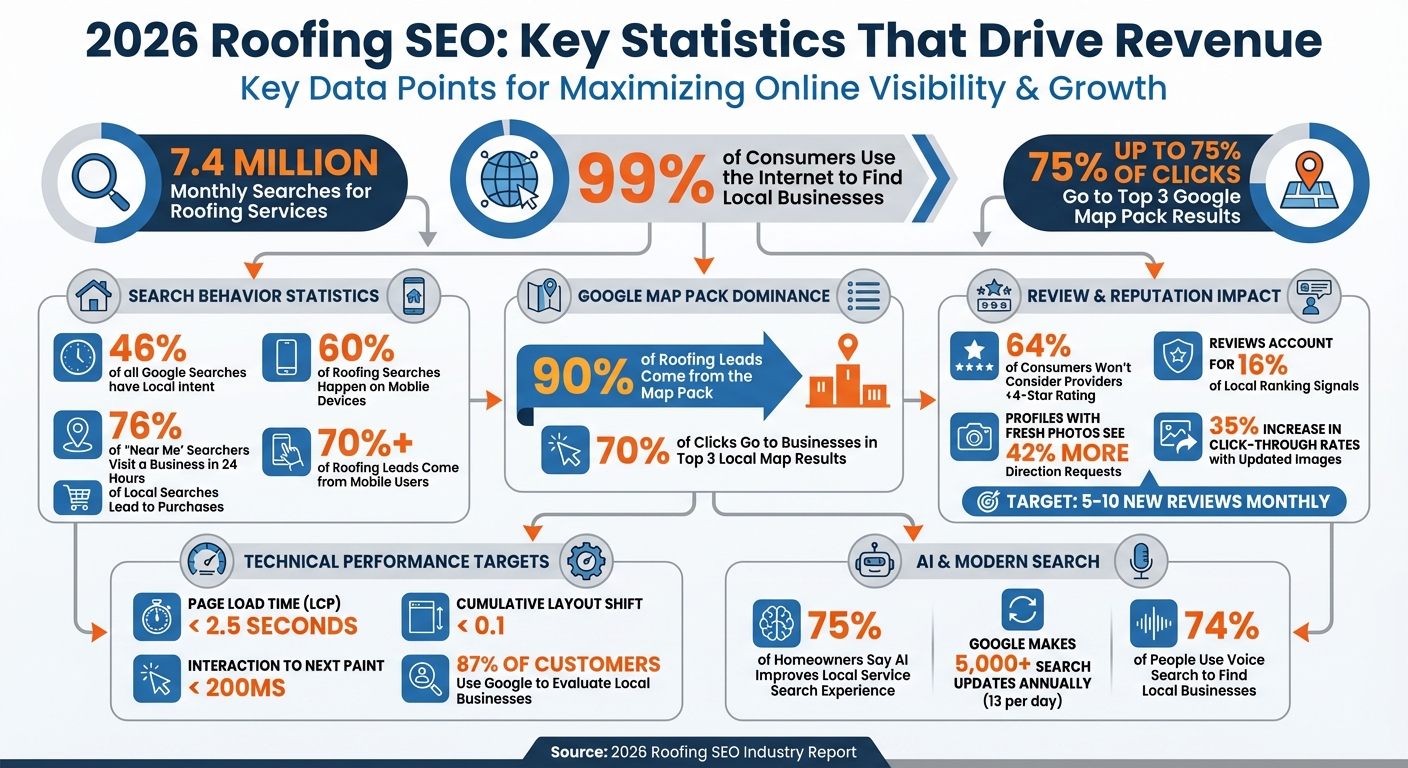
2026 Roofing SEO Statistics and Key Performance Metrics
Local SEO is a crucial part of a well-rounded 2026 SEO strategy for roofing companies. It directly fuels business growth. Nearly 46% of all Google searches have local intent, and when homeowners search for terms like "roofers near me", they’re often ready to hire within 24 hours. In fact, 76% of consumers conducting "near me" searches visit a business within a day. If your business doesn’t show up in Google’s Map Pack – the top three results – you’re missing out on up to 75% of potential clicks.
Key factors for ranking locally include Relevance, Distance, and Prominence. Relevance determines how well your business matches the search query, Distance measures your proximity to the searcher, and Prominence reflects your reputation and authority. Google uses data from your business profile, customer reviews, and website to calculate your ranking. For example, in 2025, Asbury Electric saw a 50% year-over-year increase in local impressions by aligning their Google Business Profile with their website content.
Your Google Business Profile (GBP) isn’t optional – it’s the most important asset for local SEO and the only way to appear in the Map Pack. Start by selecting "Roofing Contractor" as your primary category, then add secondary categories like "Roof Repair", "Metal Roofing Contractor", or "Siding Contractor" to capture niche searches.
High-quality, geo-tagged photos can make a big difference. Profiles with fresh images see 42% more direction requests and a 35% increase in click-through rates. Upload 20–40 photos each month, focusing on before-and-after shots, drone footage, and branded trucks or crews. Google values "visual freshness", so frequent updates keep your profile competitive.
Reviews are another major factor. Local reviews account for about 16% of ranking signals, and 64% of consumers won’t consider home service providers with less than a 4-star rating. Automate review requests after each job and aim to respond to all reviews within 24–48 hours. Ignoring reviews can send a negative signal to Google.
"More reviews and positive ratings can improve your business’s local ranking." – Google
Regular GBP posts – 2 to 4 per week – help maintain an active profile. Use these updates to share storm warnings, seasonal tips, or highlight recent projects. Additionally, manually add all the services you offer, such as "TPO Roofing", "Emergency Tarping", or "Insurance Claim Assistance", to the Services section. This helps you rank for detailed, long-tail keywords that match how homeowners search.
| GBP Element | Impact on 2026 Rankings | Recommended Action |
|---|---|---|
| Primary Category | Critical | Must be "Roofing Contractor" |
| Review Velocity | High | Aim for 5–10 new reviews monthly |
| Business Description | Medium (AI Signal) | Include materials (TPO, Shingle) and weather context |
| GBP Posts | Medium | 2–4 updates per week |
To capture local traffic, create separate service pages for each city or neighborhood you serve. About 28% of local searches lead to purchases, but only if your website appears in the results. Each page must have unique content – duplicate templates can result in penalties from Google.
Incorporate localized keywords in your H1 tags, such as "Emergency Roof Repair in Madison" or "Metal Roofing Contractor in Dane County." Mention landmarks, neighborhoods, and local features to strengthen geographic relevance. Include weather-related details, like hail frequency or wind patterns, and reference local building codes or popular materials.
Build trust by showcasing location-specific proof, like photos, case studies, and testimonials from customers in the area. Embed a Google Map of your service area and add LocalBusiness schema markup to provide clear location data for search engines. In 2025, Boss Mechanical saw a 70% drop in organic cost per lead and a 65% boost in total leads by implementing these types of pages.
Make sure your location pages are mobile-friendly, with a prominent "Call Now" button above the fold. Since most roofing searches are urgent and happen on mobile devices, fast-loading pages are essential. Websites that load within three seconds retain users up to 40% more often.
Citations – mentions of your business name, address, and phone number (NAP) across the web – build trust with search engines. Keep your NAP consistent across platforms like Google Business Profile, Yelp, Angi, HomeAdvisor, Facebook, Better Business Bureau, Houzz, Porch, and your local Chamber of Commerce. Audit your listings every three months to ensure accuracy.
Even small inconsistencies, like "St." vs. "Street" or outdated suite numbers, can hurt your local authority. Use data aggregators like Neustar, Factual, or Infogroup to push consistent information to smaller directories.
Every citation should include your website URL to build link equity, making it easier for search engines to crawl your site. Focus on industry-specific directories – links from roofing or construction-related sites carry more weight than general directories.
"The main takeaway here is that the more involved you are in the communities you serve, the more reason you will be giving local people to talk about and link to your business." – Miriam Ellis, Founder, Miriam Ellis Consulting
With 87% of customers using Google to evaluate local businesses before making a decision, accurate and consistent information is non-negotiable. Following these citation practices lays a strong foundation for broader digital strategies, boosting your roofing business’s online presence.
Keyword research today zeroes in on the exact phrases homeowners use when searching for roofing services. With roofing-related terms being searched approximately 7.4 million times a month, there’s a massive opportunity to capture this traffic. However, traditional tools like Semrush and Ahrefs often miss more than 50% of the actual phrases people type into search engines. These overlooked terms are typically long-tail keywords – phrases with three or more words, such as "shingle roof repair after hail storm Dallas" or "emergency roof tarping Fort Worth." While their search volumes may appear low, these keywords often convert at higher rates because they address immediate, specific needs.
The rise of conversational search has also changed how people query online. Tools like Google Gemini now prioritize context and industry-specific terminology. Keywords like "TPO roofing", "storm damage", and "asphalt shingles", along with technical terms such as "underlayment", "flashing", and "drip edge", are becoming increasingly relevant. Adding local landmarks or geographic details to these terms further boosts their effectiveness.
To get the most out of your keyword strategy, it’s essential to segment keywords based on user intent. For example:
This approach allows roofing companies to tailor their content to different stages of the customer journey.
Artificial intelligence has reshaped the way roofing businesses discover profitable keywords. For instance, Scorpion Ranking AI analyzes roofing market trends to identify high-value terms and adjusts strategies in real time to keep up with algorithm changes. DataPins offers another innovative solution by using geo-coordinates and job details from completed projects. By tagging jobs with photos and precise locations, it helps websites rank for hyper-local, long-tail queries like "metal roof installation near Lake Travis" or "commercial TPO roofing Round Rock".
Other tools like ServiceTitan Marketing Pro provide built-in analytics to track keyword performance and campaign ROI. This data-driven approach helped Nova Basement Systems grow their Google reviews from 19 (3.4-star) to 122 (4.7-star) in just one year. Meanwhile, WebFX LLM SEO Services focuses on optimizing for AI-driven search engines and large language models like ChatGPT, which 75% of homeowners believe enhance their search experience for local services.
Even Google Gemini itself acts as a keyword research tool by analyzing context across text, images, and video. Advanced AI models like GPT-4 or Gemini can simulate local homeowner behavior, creating "Target Query Maps" based on regional concerns. For instance, you could explore, "What would a homeowner in Muskoka search for if they need roofing that handles heavy snow on a lakefront property?" to uncover natural language queries.
"Google Gemini is making search more conversational and context-aware." – Scorpion
Long-tail keywords with specific location details are foundational for roofing SEO. These phrases blend core services with precise geographic markers like city names, neighborhoods, or local landmarks. Examples include "emergency roof leak repair Buckhead Atlanta" or "storm damage roof inspection Gwinnett County." While these searches may have lower volumes, they are highly effective – 76% of consumers who search for something "near me" visit a related business within 24 hours.
To capitalize on this trend, create targeted landing pages for each service and location. For example, if you offer four services (repair, replacement, installation, inspection) across five cities, you’ll need 20 unique landing pages. Each page should feature tailored content targeting phrases like "shingle roof replacement Austin" or "flat roof repair Georgetown."
Google’s "People also ask" and "People also search for" features can uncover additional location-specific queries. For instance, searching "roof repair [your city]" might reveal questions like "How much does roof repair cost in [City]?" or "Best roofing material for [City] weather." These insights can guide your content strategy.
Seasonal updates are also crucial. For example, focus on "ice dam prevention Minneapolis" in the winter or "emergency roof tarping Miami" during hurricane season. Businesses appearing in the top three local map results can capture up to 70% of clicks from location-based searches.
| Search Intent Type | Example Keyword | Best Content Format |
|---|---|---|
| Transactional | "roof repair Charleston SC" | Service/Landing Pages |
| Informational | "how to fix roof leak before rain" | Blog Posts |
| Local/Branded | "Charleston roofing contractors" | Homepage / Location Pages |
| Emergency | "emergency roofer open now" | Dedicated Landing Pages with Phone Numbers |
Performing a competitor keyword gap analysis can also reveal opportunities. Focus on keywords with search volumes as low as 50–100 monthly searches – these niche terms often yield strong results in local markets. Adding FAQ schema to your Q&A sections can help your answers appear in Google snippets, boosting visibility. And with 74% of people using voice search to find local businesses, incorporating conversational phrases like "Who’s the best roofer near me for storm damage?" can further enhance your SEO strategy.
"If you are not listed on the first page of Google results in any fashion, you are definitely missing qualified leads, sales, and job bookings." – Brandon Doyle, Director of Marketing, Blue Corona
Effective on-page SEO transforms local searches into leads by signaling your website’s relevance through elements like title tags, meta descriptions, and image details. With nearly 46% of Google searches having local intent, roofing companies must fine-tune every on-page element to attract homeowners searching for services in their area.
By refining metadata, structured data, and image optimization, you can boost your site’s visibility and performance.
Title tags are one of the most important ranking factors. For roofing companies, a strong title formula includes your main service and city right at the start. Use this structure:
[Service] [City] | [Brand Name] – [Benefit Statement]
For example: "Roof Replacement Austin | Apex Roofing – Free Same-Day Inspection".
Keep title tags between 51–60 characters to avoid truncation in search results. The H1 heading should closely align with the title tag to provide consistent signals to search engines.
While meta descriptions don’t directly impact rankings, they do influence click-through rates, which can indirectly improve your SEO. Aim for descriptions between 140–155 characters, starting with an action verb and including a local reference and a clear call to action. For example:
"Leaking roof? Schedule a free inspection today with Dallas’s top-rated storm damage specialists. Call [Phone Number] for 24/7 service".
If your company has strong reviews, highlight them – 64% of consumers only consider providers with at least a 4-star rating.
When it comes to URLs, keep them short, descriptive, and easy to read. Use lowercase letters and hyphens to separate words, like this: /services/roof-replacement-city. Avoid complex query strings, numbers, or dates. A clear, one-term-one-URL approach prevents keyword cannibalization, and each service-city page should include a self-referencing canonical tag to avoid duplication issues.
| Element | Best Practice | Recommended Length |
|---|---|---|
| Title Tag | Front-load Service + City; include Brand and USP | 51–60 characters |
| Meta Description | Action verbs, local intent, and clear CTA | 140–155 characters |
| URL | Descriptive, lowercase, hyphen-separated | Short and shallow |
| Header (H1) | Match the primary keyword in the Title Tag | N/A |
Structured data is key to enhancing your roofing website’s credibility. Use the RoofingContractor schema (a subtype of LocalBusiness) on your homepage and contact page to establish your identity as a roofing service provider. For individual service pages – like repairs, replacements, or inspections – add Service schema to help Google understand your offerings. If you operate in multiple cities, create a separate LocalBusiness schema block for each location page with unique Name, Address, and Phone (NAP) data.
Structured data is increasingly essential for appearing in Google’s AI Overviews. Google Search Central explains:
"Structured data is a standardized format for providing information about a page and classifying the page content".
Websites using structured data often see better performance. For instance, Rotten Tomatoes experienced a 25% higher click-through rate, while Nestlé saw an 82% increase for pages displayed as rich results. Roofing companies can leverage the AggregateRating schema to display star ratings directly in search results, a powerful visual trust signal when 64% of consumers favor providers with at least a 4-star rating.
FAQPage markup is another useful tool. Use it to address common topics like insurance claims, warranties, or financing, which can help your site appear in People Also Ask boxes and AI citations. Implement structured data using JSON-LD format, embedding it as a JavaScript snippet within your HTML <script> tag. Validate your code using Google’s Rich Results Test or Search Console to ensure it’s error-free and eligible for enhanced display.
Images play a crucial role in both user experience and SEO, but they can also slow down your site if not optimized. Use next-generation formats like WebP or AVIF, compress images to under 200 KB, and strip unnecessary GPS/EXIF metadata. Tools like Tinify can help reduce file sizes without sacrificing quality. Optimized images are essential for meeting Core Web Vitals standards.
Descriptive filenames are another must. Replace generic names like "IMG001.jpg" with something meaningful, such as "metal-roof-repair-austin.webp". Alt text should describe the image while naturally incorporating keywords. For instance: "New standing-seam metal roof installation in Round Rock". This practice not only improves SEO but also enhances accessibility for visually impaired users.
Nolen Walker, Founder of Roofing Webmasters, advises:
"The best images are always original; they are shots of your actual company, facility, employees, equipment, and transportation".
Use real photos of your roofing crews, branded trucks, and actual job sites – especially before-and-after shots – to build trust and increase conversions. Enable lazy-loading for images below the fold to speed up initial page loads. Additionally, use the srcset attribute or <picture> element to serve appropriately sized images based on the user’s device. These steps ensure your site is both visually appealing and fast, complementing your overall on-page strategy.
Technical SEO ensures that search engines can efficiently find, crawl, and index your roofing website. Even the best content and keyword strategies won’t succeed without a solid technical foundation. While on-page SEO focuses on content and metadata, technical SEO ensures the infrastructure supports these efforts. As Maria Harutyunyan, an SEO Specialist, puts it:
"A technically sound site loads fast, works flawlessly on mobile, and communicates its content clearly to Google."
With 60% of roofing searches happening on mobile devices, often during emergencies, your website must perform seamlessly under pressure. Issues like slow loading times or crawl errors can cost you valuable leads. Considering that over 70% of roofing leads come from mobile users, optimizing your site’s technical performance is critical.
Mobile performance directly impacts whether potential customers stay on your site or leave for a competitor. Homeowners typically won’t wait more than 3 seconds for a page to load. Every additional second increases the risk of losing engagement – and revenue.
In 2026, Interaction to Next Paint (INP) replaced First Input Delay as the key responsiveness metric. Your site needs to respond to user interactions within 200 milliseconds. As Frontend Horizon explains:
"Interaction to Next Paint replaced First Input Delay as the decisive metric, and any INP above 200 ms now drags pages below faster-loading rivals."
To improve mobile speed, use next-gen image formats and compress files for faster loading. Preload your hero image to ensure it appears instantly. Minify and defer third-party scripts, like chat widgets or tracking codes, to prevent them from slowing down the main thread.
For faster delivery of assets, implement server-side caching and use a Content Delivery Network (CDN) with adaptive bitrate delivery. Prioritize prominent call-to-action elements, like "Request a Quote" buttons, to engage mobile users effectively.
| Metric | Target for 2026 | Impact on Roofing SEO |
|---|---|---|
| Largest Contentful Paint (LCP) | Under 2.5 seconds | Ensures the main hero image or offer loads quickly |
| Interaction to Next Paint (INP) | Under 200 milliseconds | Measures responsiveness to user actions |
| Cumulative Layout Shift (CLS) | Under 0.1 | Prevents layout shifts during loading |
Tools like Google PageSpeed Insights and Lighthouse can help you monitor Core Web Vitals and identify performance bottlenecks. Regularly testing both mobile and desktop versions ensures your site stays competitive.
An XML sitemap helps search engines locate and index your most important pages. Include high-value sections such as service pages, location pages, and blogs. For example, URLs like /services/roof-replacement-austin and /locations/dallas should be prioritized, while administrative pages, thank-you pages, and duplicates should be excluded.
Submit your sitemap through Google Search Console to confirm that Google can access all your key pages. Regular audits are essential – remove URLs with 404 errors or unnecessary parameters that waste your crawl budget.
The robots.txt file directs search engine bots on what to crawl and what to avoid. Proper configuration prevents sensitive areas from being indexed while ensuring essential assets are accessible. Recommended rules include:
User-agent: * (applies to all crawlers)Disallow: /admin/ or /wp-admin/ to block backend areasDisallow: /thank-you/ to hide conversion pagesAllow: /wp-content/uploads/ to ensure images and project photos are indexedSitemap: https://yoursite.com/sitemap.xml to specify the sitemap location Keep URLs concise and descriptive, structured logically, such as /services/storm-damage-repair. This improves crawler understanding and minimizes indexing issues.
Tracking tools help measure the effectiveness of your SEO efforts and pinpoint areas for improvement. Google Search Console (GSC) is essential for monitoring search traffic, indexing status, and crawl errors. Use the URL Inspection tool to see how Google views your pages and submit new ones for indexing.
Guy Leon, Founder of betterweb.ai, emphasizes:
"Google Search Console is your go-to for monitoring and improving your site’s visibility in search results."
Google Analytics 4 (GA4) provides insights into user behavior, conversion rates, and engagement metrics like bounce rates and session durations. For roofing businesses, tracking conversions from phone calls, forms, and quote requests is crucial to identifying high-performing pages.
Tools like CallRail allow you to track phone leads and tie them back to specific SEO pages or campaigns. This data shows which keywords and landing pages generate the most business.
Use Screaming Frog SEO Spider to crawl your site and identify technical issues like broken links, duplicate content, or missing metadata. Monthly audits can prevent problems from affecting your rankings. Additionally, Google Looker Studio enables you to create shareable SEO dashboards by combining data from GSC, GA4, and other sources.
Finally, ensure your site uses HTTPS with an SSL certificate. Google flags insecure sites, which can erode trust and harm rankings. Consistently verify that your Name, Address, and Phone (NAP) details match across your website, Google Business Profile, and local directories to build credibility with search engines.
If you’re in the roofing business, quality content isn’t just a nice-to-have; it’s what gets you noticed. Homeowners searching for answers to real-life problems – like what to do after a hailstorm or how to handle a leaking roof – are your potential customers. Your website needs to provide those answers before your competitors do.
Content marketing helps you build trust before that first phone call even happens. Think about it: when someone Googles "how much does a roof replacement cost" or "signs of hail damage", they’re not just gathering information – they’re sizing up your expertise. As Scorpion puts it:
"If your website and online presence provide real value – authoritative answers, a great user experience, and proof of trustworthiness – you stand a strong chance of ranking at the top of Google."
While SEO gets your site seen, high-quality content keeps people engaged. With AI-driven search tools like Google Gemini prioritizing comprehensive and helpful content, your website must prove its value. That means showing off your expertise with certifications like GAF Master Elite, using real project photos, and sharing detailed case studies. Generic content won’t cut it anymore, especially when 75% of homeowners say AI improves their experience searching for local home services. To stay competitive, your content needs to address specific homeowner concerns and convert those searches into leads.
A winning strategy starts with creating dedicated pages for each service you offer. Whether it’s roof repair, emergency tarping, shingle replacement, or storm damage restoration, each service should have its own page. Use industry-specific terms like "underlayment", "flashing", "drip edge", and "TPO" to show expertise and boost search rankings.
Your content also needs to match the intent behind different types of searches. For instance:
Including expert advice – like "After installing over 200 flat roofs in this area, we recommend…" – can further establish your credibility. Don’t forget to highlight certifications, licenses, and years of experience to set yourself apart.
Take a cue from Boss Mechanical, which saw a 70% drop in organic cost per lead and a 65% increase in total leads by focusing on service-specific pages that answered customer questions instead of offering generic descriptions.
Cost guides are another must-have. Pages like "Roof Replacement Cost in Austin" attract homeowners searching for detailed pricing information. Break down costs, explain what factors affect them, and include FAQs about insurance, warranties, and timelines to snag rich snippets in search results.
Localization is key, too. Mention local weather challenges and building codes to make your content more relevant. For example, a Miami roofing company should address wind zone requirements, while a Denver roofer might focus on snow load considerations.
Finally, optimize for mobile. Since 80–90% of roofing searches happen on mobile devices, make sure your pages load fast (under three seconds) and include a sticky click-to-call button for emergencies.
Your service pages are just the beginning. Blog posts are a great way to tackle common roofing issues and build your authority. These posts capture homeowners researching problems before they’re ready to hire. For example, write about topics like "how to spot hail damage on shingles" or "signs your roof needs replacement" to answer specific questions.
Focus on local weather-related problems. A roofer in Texas might publish posts like "How Hail Storms Damage Roofs in Dallas" or "Preparing Your Roof for Hurricane Season in Houston." In Colorado, topics like "Winter Roof Maintenance Tips for Denver Homes" or "How Heavy Snow Affects Roof Lifespan in the Rockies" would resonate more.
Timing matters. After a major storm, publish posts on identifying hail damage, filing insurance claims, and emergency repairs. Seasonal guides – like winter maintenance tips before the first snowfall – are also effective.
Structure your blog posts to answer conversational questions that people might ask through voice search. For instance, instead of writing "roof leak repair", try "What Should I Do If My Roof Is Leaking?" or "How Do I Know If My Roof Has Storm Damage?" With 57% of smart-speaker owners making purchases through voice commands, this approach can drive more traffic.
Use semantic SEO by naturally incorporating roofing terms like "ice dams", "granule loss", "soffit ventilation", and "ridge vents" into your posts. This helps search engines understand your expertise and boosts your chances of being featured in AI-driven summaries.
Visuals are just as important. Include before-and-after photos, geo-tagged project images, and even drone footage of completed jobs. Use modern image formats like WebP or AVIF to maintain quality without slowing down your site.
FAQ schema can also make a big difference. Mark up common questions about costs, timelines, and processes to capture featured snippets and "People Also Ask" boxes. These often appear above regular search results, driving more clicks.
Onit Roofing is a great example of this strategy in action. By creating targeted blog content on local roofing problems, they moved 22 new keywords to the first page of Google search results. Their posts focused on answering specific homeowner questions with detailed, locally relevant information.
To turn blog readers into leads, offer downloadable resources like "Storm Damage Checklists" or "Roof Inspection Cheat Sheets" in exchange for an email address. This helps you capture contact info from homeowners still in the research phase.
Keep your blog content fresh by updating it quarterly with new stats, pricing tables, and project photos. Google rewards updated content, and adding details about recent weather events or changes in building codes keeps your posts relevant.
| Content Type | Example Topic | Searcher Intent |
|---|---|---|
| Informational | "How to spot hail damage on shingles" | Researching a problem |
| Transactional | "Emergency roof tarping in Austin" | Ready to hire immediately |
| Comparison | "Asphalt vs. Metal Roofing for Texas weather" | Evaluating options |
| Local/Branded | "Dallas roofing insurance claim guide" | Seeking local expertise |
Since less than 1% of searchers click past the first page of Google results, it’s crucial to aim for page-one rankings. Focus on niche, local topics where you can realistically compete instead of chasing broad, national keywords.
Once you’ve fine-tuned your on-site SEO, it’s time to focus on off-page strategies like securing quality backlinks and maintaining accurate citations. These elements work together to enhance your roofing business’s visibility and credibility.
Off-page SEO refers to activities outside your website that improve your search rankings. For roofing companies, this means acquiring backlinks from reliable, relevant sources and ensuring your business details are consistent across the web. While on-site SEO explains your services to Google, off-page signals prove your legitimacy and trustworthiness within your community.
The SEO landscape has shifted significantly in recent years. As Brian Dean from Backlinko explains:
"Context beats the <href> tag".
Today, search engines value mentions of your business in a relevant context, even without direct links. For instance, appearing in a local "top 10 roofers" list or a community forum can help AI models like ChatGPT and Google Gemini associate your brand with roofing services.
For roofing companies, local relevance carries more weight than domain authority. A backlink from your city’s newspaper or Chamber of Commerce is far more impactful than one from a national blog with no local ties. When competing for the Google Map Pack (the top three local results), it’s worth noting that these listings absorb up to 70% of clicks for location-based searches.
Building backlinks is a critical step in solidifying your local authority. The quality of these links matters more than sheer quantity.
Here are some effective ways to earn backlinks:
You can also secure editorial backlinks by pitching unique insights to local journalists. For example, compile data on recent hailstorm damage or average roof replacement costs in your area and share it with reporters covering home improvement or weather-related stories.
Another effective technique is the Moving Man Method. Identify outdated roofing resources or competitors that have closed, then contact websites still linking to those pages and suggest your updated resource as a replacement. Platforms like Featured.com or HARO are also great for offering expert quotes to journalists writing about home maintenance or storm safety.
Conducting a link gap analysis can help uncover opportunities. Use SEO tools to find websites that link to your competitors but not to you. These sites are likely to be open to linking to a relevant roofing business. When reaching out, highlight how your link would add value, such as appearing on a "Recommended Contractors" page.
Brian Dean’s collaboration with Black Lapel demonstrates the impact of strategic partnerships. His guest post on a relevant site not only brought in over 150 direct sales in a year but also created a branded association that AI models now recognize. As Dean puts it:
"The real goal isn’t just to earn links – it’s to become part of the conversation".
| Backlink Source Type | Relevance Level | Primary Benefit |
|---|---|---|
| Local News/Blogs | High (Local) | Strengthens proximity signals for Map Pack |
| Manufacturer Sites | High (Industry) | Builds industry authority and credibility |
| Local Chambers | High (Local) | Provides trust and location verification |
| Niche Guest Posts | Medium | Boosts brand visibility and awareness |
| Business Partners | Medium | Generates referral traffic and co-citation |
Citations, or mentions of your business name, address, and phone number (NAP), play a vital role in reinforcing your local presence and search engine credibility.
Search engines use citations to verify your business’s legitimacy and location. Even "nofollow" directory links contribute to trust signals, particularly for newer roofing businesses. However, consistency is key. Any discrepancies in your NAP across directories can confuse search engines and hurt your rankings.
Make sure your business information is identical across all platforms, including your Google Business Profile, website footer, and directory listings. Miriam Ellis from Moz highlights the importance of this:
"Ignoring reviews [and citations] results in a failure to serve and engage with your existing consumer base, win back customers who have left negative reviews, and benefit from the business intelligence gained when review sentiment is analyzed".
Here’s how to manage citations effectively:
Citations not only enhance "prominence", one of Google’s key local ranking factors, but also make your business eligible for AI-generated search summaries. With 76% of smartphone users visiting a business within 24 hours of searching for it, accurate citations can directly influence customer acquisition.
The roofing industry is especially sensitive to citation accuracy. High-demand storm seasons often lead to ranking fluctuations, and inconsistent citations can worsen the problem. A 2025 Google update has made it even harder for businesses to appear in both the Map Pack and organic results, increasing the competition for citation-driven rankings.
| Citation Type | Examples | SEO Benefit |
|---|---|---|
| Major Directories | Yelp, Facebook, Bing, Apple Maps | Builds foundational trust and authority |
| Industry Niche | Angi, HomeAdvisor, Porch | Enhances relevance for roofing-specific queries |
| Local/Community | Chamber of Commerce, Local News | Strengthens local signals and trust |
| Data Aggregators | Foursquare, Data Axle | Ensures consistency across platforms |
Finally, track down unlinked mentions of your business. Use Google search operators like intext:"Your Company Name" -site:yourwebsite.com to find mentions without links and request that they be updated to clickable links. These small wins can collectively strengthen your online presence.
In 2026, artificial intelligence is reshaping how roofing companies handle SEO. AI tools now conduct website audits and generate content ideas in mere minutes. But it’s not just about speed – it’s about preparing your website for AI Engine Optimization (AEO) so trusted AI models reference your content.
As roofing businesses deal with challenges like mobile-first indexing and improving local visibility, AI tools offer precise solutions that go beyond traditional SEO methods. According to The Scorpion Pulse, 75% of homeowners believe AI enhances their experience when searching for local home services. With Google rolling out over 5,000 search updates in 2024 – averaging around 13 updates daily – keeping up manually is no longer feasible. AI tools now track these updates automatically, adjusting strategies in real time.
Adam Sand, an AI marketing strategist, explains the shift this way:
"AI search tools now use vector embeddings that understand meaning, not just keywords. Roofers who structure content around ideas – not just phrases – will dominate AI-powered discovery".
This means focusing on semantic relationships and entity signals rather than just keyword repetition. For example, teaching AI that "Metal roofs → reflect → sunlight" establishes stronger topical authority than simply repeating "metal roofs" throughout your content.
AI tools are now seamlessly integrated into every aspect of roofing SEO, making strategies more efficient and results-driven.
AI-powered auditing tools can comb through your website, identifying technical issues and content gaps. These tools don’t just flag broken links or slow load times – they also analyze how well your content covers roofing topics and whether AI models can easily interpret your information.
These audits align with mobile optimization and sitemap strategies to ensure your site meets modern standards.
For instance, Firecrawl extracts your site’s content into Markdown format, enabling AI agents to evaluate your topical coverage and internal linking. Meanwhile, Scorpion Ranking AI analyzes your local market to find high-value keywords that drive revenue rather than just traffic. It automatically adjusts strategies based on algorithm changes, so you’re not left scrambling to adapt.
For more comprehensive strategy work, Manus acts as an advanced AI platform. It conducts in-depth research, develops marketing strategies, and even peer-reviews plans created by other AI models. This peer-review system – where one model (like Gemini) checks another (like GPT-4) – helps ensure accuracy.
An effective AEO audit might involve running 25+ buyer-focused prompts through tools like GPT-4, Gemini, and Perplexity, asking questions such as "Who is the best metal roofer in [Your City]?" or "What company should I call for emergency roof repair in [Your Area]?". If your business isn’t cited in these AI-generated answers, you likely have a visibility problem that traditional SEO metrics won’t catch.
| Tool Category | Recommended AI Tools | Primary SEO Function |
|---|---|---|
| Audits & Scraping | Firecrawl, Manus, Scorpion Ranking AI | Technical health checks, content inventory, market analysis |
| Content Generation | GPT-5, Gemini 2, Perplexity | Drafting localized blogs, service pages, homeowner guides |
| Reputation/Reviews | Semrush Review Management, Broadly AI | Automated review responses, sentiment analysis |
| Lead Engagement | Scorpion Connect, Local AI Chatbots | 24/7 customer Q&A, appointment scheduling |
AI is also revolutionizing how roofing companies create and structure content for better results.
Producing quality content has always been a challenge for roofers. AI tools now generate blog drafts, service pages, and homeowner guides, but the real value lies in structuring this content to maximize AI discovery.
Large language models like GPT-4/5, Gemini 2, and Perplexity create localized content based on market data – such as regional climate trends – to craft seasonal posts on topics like ice dam prevention or hurricane preparation.
A key strategy is using "answer-bait" formatting. This involves breaking content into 150–300 word sections with clear subheadings, making it easier for AI models to process and summarize your expertise. Instead of writing long, uninterrupted articles, organizing your content into smaller, digestible pieces helps directly address homeowners’ questions.
Additionally, tools like Semrush Review Management leverage AI to craft professional, on-brand responses to Google reviews quickly. This is crucial because Google’s AI Overviews often pull directly from your Google Business Profile, including your description, services, and reviews. Consistent and polished review responses can boost your credibility with both people and AI systems.
For lead engagement, Scorpion Connect with AI Chat interacts with website visitors 24/7, answering technical roofing questions and scheduling appointments in real time. This ensures that potential customers get immediate assistance, reducing the chances they’ll leave your site for a competitor.
Some roofing companies are even shifting from static PDFs to interactive chatbots for presenting SEO strategies. These chatbots allow stakeholders to ask questions about ROI or project timelines anytime, emphasizing a move toward conversational, AI-driven interactions.
A practical approach might include using AI to build FAQ sections for common roofing questions, then adding FAQ schema markup to improve visibility in traditional search results and AI-generated answer cards.
Executing effective SEO strategies is only half the battle; measuring the right metrics ensures your efforts translate into qualified leads, booked jobs, and real revenue. In 2026, it’s not just about ranking for keywords but driving tangible business outcomes. As Brian Dean from Backlinko puts it:
"The biggest mistake I see SEOs make is chasing rankings and traffic instead of revenue".
With Google rolling out approximately 4,500 algorithm updates each year, having a proactive monitoring system is critical. You need tools and frameworks that can quickly detect issues and uncover opportunities before your competitors do. In the age of AI-driven search, tracking your "share of voice" in platforms like ChatGPT and Gemini has become essential.
The focus should always be on metrics that directly impact your bottom line: qualified leads, booked appointments, and cost per acquisition. WebFX echoes this sentiment:
"SEO success is measured by calls, estimates, and revenue, not traffic alone".
For local businesses, maintaining visibility in the Map Pack is crucial. If you’re not in the top three results, you’re likely missing out on most local-intent traffic. Additionally, keep an eye on your review velocity – aim for 5–10 new reviews each month to stay competitive. It’s worth noting that 64% of consumers only consider service providers with a rating of at least 4 out of 5 stars.
On the technical side, Google has shifted its focus to Interaction to Next Paint (INP) as the key page experience metric, replacing First Input Delay. Your INP should stay under 200 milliseconds on both 4G and Wi-Fi connections. Another critical metric is Largest Contentful Paint (LCP), which should remain under 2.5 seconds for optimal user experience.
| Metric Category | Key Metric | Target/Benchmark |
|---|---|---|
| Conversion | Qualified Leads / Booked Jobs | Varies by goal |
| Local SEO | Map Pack Ranking Position | Top 3 |
| Technical | Interaction to Next Paint (INP) | < 200 ms |
| Technical | Largest Contentful Paint (LCP) | < 2.5 sec |
| Reputation | Review Velocity | 5–10 new reviews/month |
| Brand | Brand Search Volume | Upward trend |
Tracking brand search volume is another critical measure of success. An upward trend in searches for your company name shows that your off-page SEO and reputation-building efforts are paying off. Similarly, focus on organic traffic to high-converting pages – like service pages or guides on "roof replacement cost" – instead of obsessing over total blog traffic.
Case studies highlight the impact of localized SEO strategies. For instance, Asbury Electric’s focus on optimizing their Google Business Profile and service areas led to a 50% year-over-year increase in impressions from local SEO. Similarly, Boss Mechanical saw a 70% decrease in organic cost per lead and a 65% boost in total leads by targeting high-intent keywords and refining on-page SEO.
To stay on top of your performance, monitor Map Pack rankings and reviews daily, organic traffic and conversions weekly, and conduct competitive analysis monthly.
To turn metrics into actionable insights, you’ll need the right tools. Start with Google Analytics 4 (GA4) and Google Search Console. GA4 helps track user behavior, conversion rates, and organic revenue, while Search Console provides data on click-through rates, impressions, crawl errors, and Core Web Vitals.
For competitive analysis and keyword tracking, SEMrush and Ahrefs are invaluable. They offer insights into competitor strategies, backlink profiles, and your share of voice in search results. Use Google PageSpeed Insights to regularly audit Core Web Vitals and INP performance.
Behavioral analysis tools like Hotjar and Crazy Egg provide heatmaps that show how users interact with your site. These insights can guide layout adjustments and improve user engagement. Additionally, Google Data Studio (Looker Studio) allows you to consolidate data from GA4 and Search Console into a single, real-time dashboard for quick decision-making.
For industry-specific needs, tools like Scorpion RevenueMAX use AI to score leads and prioritize the most promising ones. DataPins strengthens your local SEO by adding geo-tagged project proof, while BrightLocal (starting at $39/month) automates citation building and local rank tracking with precision.
Don’t forget to include call tracking to measure leads generated from SEO and PPC efforts accurately. Finally, add a personal touch by asking customers how they found you during intake calls – this qualitative data can reveal SEO successes that analytics tools might miss.
The roofing industry in 2026 demands a fresh approach to SEO. Success now revolves around dominating locally with a strong Google Business Profile, leveraging AI-driven keyword strategies, and ensuring top-notch mobile performance. Considering that 46% of Google searches have local intent and 90% of roofing leads come from the Map Pack, your online presence isn’t just about visibility – it’s your main sales engine. This marks a major shift from traditional SEO to an AI-focused strategy.
AI-driven SEO is reshaping the game entirely. Beyond the Experience, Expertise, and Trustworthiness we’ve highlighted, your content must now meet AI’s expectations. Think of your website as your AI portfolio, displaying your expertise with certifications, project images, and consistent, accurate information. As Adam Sand from Roofing Business Partner aptly puts it:
"Your website is now an AI résumé. You’re effectively applying to be part of the AI’s answer".
Consistent and strategic SEO efforts are directly tied to revenue growth. Location-specific content and targeted optimization deliver measurable results, proving their value time and time again.
With Google making over 5,000 search updates annually – about 13 changes every day – staying stagnant is not an option. Set a quarterly schedule to audit your website and Google Business Profile, aim for 5–10 new reviews each month, and keep an eye on your Core Web Vitals to ensure your site loads in under 2.5 seconds. As Ashlyn Haworth from WolfPack Advising reminds us:
"SEO is ongoing maintenance, not a one-time task".
AI tools offer roofing companies a way to boost their SEO efforts by taking over tasks that often eat up valuable time, like keyword research and content creation. These tools can pinpoint high-value, roofing-related keywords and produce well-optimized, engaging content that aligns with local search trends.
Beyond content creation, AI can also evaluate website performance, keep tabs on site health, and suggest ways to improve mobile usability – all of which are crucial for climbing search engine rankings. With AI-powered analytics, roofing businesses can even anticipate shifts in search algorithms, giving them a competitive edge. This proactive approach helps attract more high-intent leads and strengthens their online visibility.
To evaluate how well your roofing business’s SEO is performing, pay attention to a few key areas. Start with tracking your local search visibility and keyword rankings – this ensures your website is showing up prominently when potential customers search for roofing services in your area. Another critical metric is your Google Business Profile performance. Keep tabs on views and clicks here, as it’s a vital tool for drawing in local clients.
Don’t stop there – dig into conversion metrics like phone calls, contact form submissions, and appointment requests. These figures help you understand how effectively your SEO efforts are turning online interest into real customer actions. Together, these metrics give you a solid snapshot of your online presence and how well you’re connecting with potential customers.
Local SEO plays a crucial role for roofing companies in 2026, as the majority of homeowners turn to online searches to find roofing services nearby. By focusing on local search optimization, your business can connect with potential customers right when they need roofing solutions in your area.
A well-executed local SEO strategy helps your company appear in local map packs, attract more qualified leads, and convert those leads into actual jobs. It ensures your roofing business stays visible where it counts – both on search engines and within your local community – giving you an edge in a highly competitive, location-driven industry.


 Physical Therapy
 MedSpa
 Dental
 HVAC
HVAC Roofing
 Pest Control
 Cleaning Services
 Landscaping
 Hotel
Hotel Cruise
 Branding
 Content Marketing
 Email Marketing
 Graphic Design
 PPC (Online Ads)
 SEO (Search Engine Optimization)
 Website Design and Development
 Pest Control
 Plastic Surgeon
 Roofing