If your HVAC business isn’t ranking on the first page of Google, you’re losing customers. In 2026, most homeowners search online for local HVAC services, with 97% researching contractors before making a decision. And here’s the kicker: 75% of users never scroll past the first page of results. This means showing up in Google’s "Local 3-Pack" is essential for capturing high-intent leads.
Here’s a quick breakdown of what works in 2026:
These strategies focus on visibility where it matters most – local search. If your site isn’t mobile-friendly, optimized for local intent, and leveraging AI-driven tools, it’s time to rethink your approach. The HVAC market is competitive, but with the right SEO tactics, you can attract more leads and grow your business.
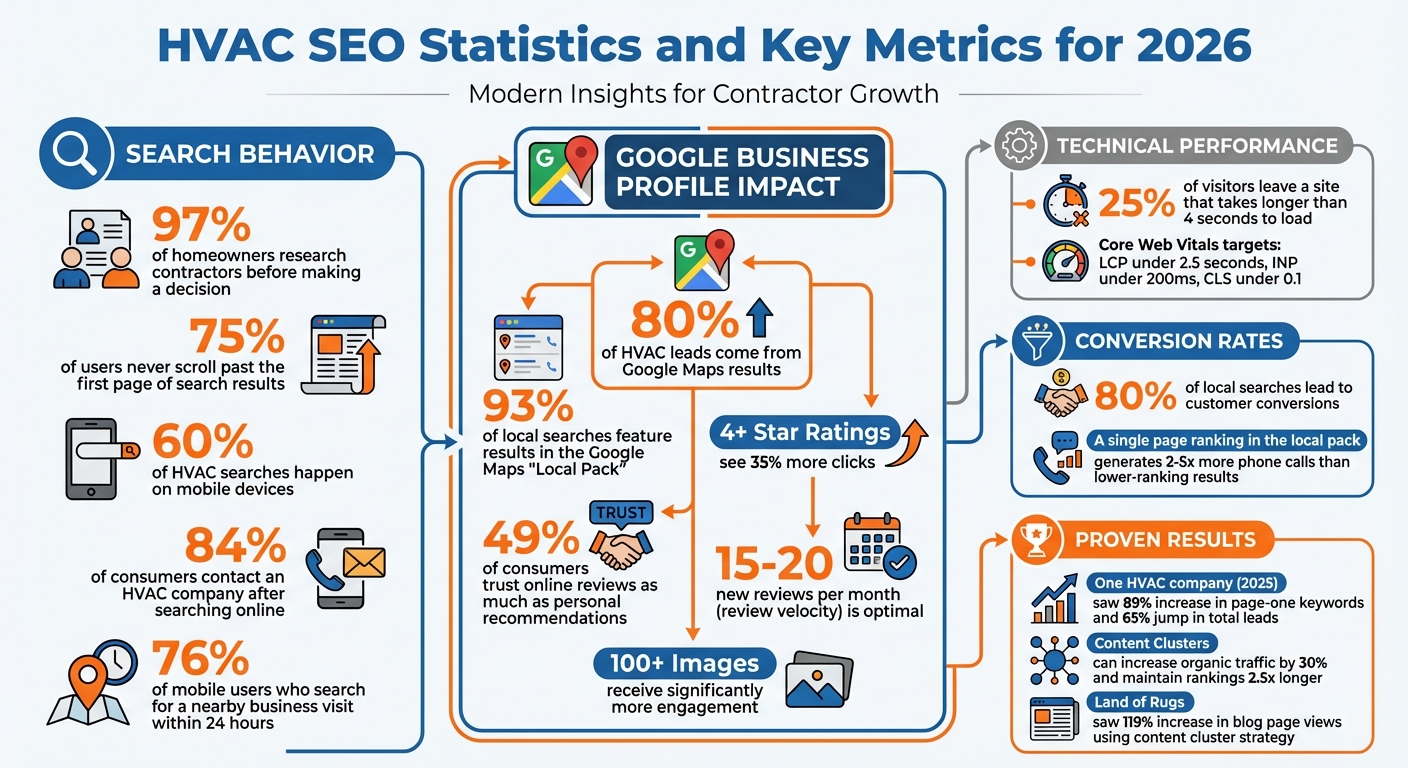
HVAC SEO Statistics and Key Metrics for 2026
Your Google Business Profile (GBP) is one of the most effective tools for improving your local SEO presence. Over 80% of HVAC leads come directly from Google Maps results, and 93% of local searches feature results in the Google Maps "Local Pack". Without a fully optimized profile, you risk losing valuable leads to competitors who are more visible.
An optimized GBP is the backbone of your local SEO efforts. Start by ensuring that your Business Name, Address, and Phone Number (NAP) are consistent across all platforms, including your website, social media, Yelp, and the Better Business Bureau. Set "HVAC Contractor" as your primary category and choose 4–5 related secondary categories, such as "Air Conditioning Repair Service", to improve keyword rankings.
Define your service areas by specifying cities, neighborhoods, or ZIP codes instead of using a general radius. Clearly list your regular business hours, holiday hours, and 24/7 emergency service hours, which can help you capture urgent searches like "emergency AC repair". Include detailed descriptions of your services along with price ranges. Enable the "Chat" feature to allow customers to message you directly, and add FAQs to the Q&A section that address topics like diagnostic fees or financing options.
Once your profile is complete, managing your reviews becomes crucial. Google prioritizes review velocity, meaning a steady flow of 15 to 20 new reviews each month is more impactful than simply accumulating a large number of older reviews. Encourage technicians to ask for reviews during service visits, and use tools like DataPins, ServiceTitan, or BirdEye to send automated review requests immediately after a job is completed. Simplify the process by including a short link or QR code on invoices or service vehicles that directs customers to your Google review page.
"Google reviews appear beside your Google listing on Google Maps and Search and often influence users’ perceptions of your HVAC company." – HVAC Webmasters
Respond to every review, whether it’s glowing or critical. Thank customers for positive feedback and address negative reviews with professionalism – express regret, avoid defensiveness, and invite the reviewer to discuss their concerns privately. Nearly half of consumers (49%) trust online reviews as much as personal recommendations, and businesses with a four-star rating or higher see 35% more clicks.
Keeping your profile active with regular updates, photos, and videos helps maintain engagement. Add high-quality images and one 15-second vertical video each week. Showcase before-and-after shots, branded visuals, or technicians in action to draw in potential customers. Profiles with over 100 images receive significantly more engagement than those with fewer.
Use Google Posts to highlight seasonal offers, such as "Spring AC Tune-Up Specials" in March or "Winter Emergency Furnace Repair" in October. Share helpful content like maintenance tips, troubleshooting advice, and seasonal checklists, along with promotions and financing options. Geo-tag images and add alt text that combines your service and location, such as "AC Repair in Dallas". As of 2026, Google is prioritizing short vertical videos over static images, so include at least one 15-second clip weekly. For example, feature a technician demonstrating a quick tip or showcasing a completed installation.
Optimizing your GBP lays the groundwork for the technical SEO and content strategies discussed in later sections.
As HVAC SEO continues to grow in importance in 2026, having a solid technical foundation is non-negotiable. Technical SEO ensures that Google can find and rank your HVAC content. Without it, even the best content might never see the light of day. A big part of this foundation is meeting Core Web Vitals, which are three key metrics Google uses to measure your site’s performance: Largest Contentful Paint (LCP) under 2.5 seconds, Interaction to Next Paint (INP) under 200 milliseconds, and Cumulative Layout Shift (CLS) under 0.1.
With Google’s shift to mobile-only indexing, 60% of all searches now happen on mobile devices. This means your mobile site is the main factor in determining your rankings. If your mobile experience is flawed, your entire SEO strategy could fall apart. And the stakes are high – 25% of visitors will leave a site that takes longer than four seconds to load, and 75% of users never scroll past the first page of search results.
To improve speed and performance, start with your images. Replace JPG and PNG files with WebP or AVIF formats, which can reduce file sizes by up to 80%. Use lazy-loading for images and videos that aren’t immediately visible, so the content above the fold loads faster. Defer non-critical JavaScript by moving it to the footer and using defer or async attributes to prevent it from slowing down page rendering.
Enable browser and server caching to speed up repeat visits, and minify your CSS, HTML, and JavaScript files by removing unnecessary characters and spaces. For mobile users, simplify your navigation to include just 5-7 main menu items, and make sure important service pages like "AC Repair" are accessible within two taps. Add a clickable phone number in your header and a sticky footer that stays visible as users scroll, making it easy for emergency callers to contact you immediately.
"If your mobile experience is broken, your entire SEO strategy is broken." – Search Engine Land
In 2025, Google replaced First Input Delay (FID) with Interaction to Next Paint (INP), which measures how your site responds to all user interactions, not just the first click. To keep your INP under 200ms, break up long JavaScript tasks into smaller chunks of less than 50 milliseconds. Also, reserve specific dimensions for images, ads, and dynamic elements in your code to avoid layout shifts that disrupt the user experience.
Once you’ve optimized your site’s speed and mobile navigation, focus on building trust and usability through security and accessibility improvements.
Security is a key factor for both user trust and SEO rankings. Install an SSL certificate to enforce HTTPS across your site. Google favors secure websites, and users are more likely to trust sites with HTTPS, especially when entering personal information or payment details. Ensure all HTTP versions of your pages redirect to HTTPS to avoid mixed content errors that can trigger security warnings. You can also implement security headers like Content-Security-Policy (CSP) and Strict-Transport-Security (HSTS) to further protect user data.
"Google favors secure websites, and an HTTPS connection builds trust with users. If your HVAC website isn’t secure, you may lose potential customers and risk lower rankings." – Hook Agency
Accessibility not only enhances the user experience but also boosts SEO. Add descriptive alt text to all images to help search engines understand your content and make your site usable for visually impaired visitors. Ensure touch targets are at least 44×44 pixels and body text is set to 16 pixels for better usability on mobile devices. Use tools like Google Search Console‘s Core Web Vitals report and PageSpeed Insights to track your site’s performance and identify areas for improvement.
Focusing on long-tail keywords – specific phrases like "24-hour emergency furnace repair in Midtown Houston" (difficulty 1–20%) – can help you attract high-intent leads. These phrases are much more effective than competing for broad terms like "AC repair", which often have a keyword difficulty of 60% or higher. Why? Because these detailed searches often come from people who are ready to act. In fact, 84% of consumers contact an HVAC company after searching online, and 76% of mobile users who search for a nearby business visit that business within 24 hours.
This highlights how crucial it is to target localized long-tail queries for immediate service calls. When someone searches for "who can fix my air conditioner today near me", they’re not just browsing – they’re ready to pick up the phone. To capture these leads, your content needs to combine your services with geographic terms and mirror the natural language your customers use. This strategy works alongside broader SEO efforts to meet the immediate needs of potential customers.
AI tools like Semrush, LowFruits, AnswerThePublic, and ChatGPT can help uncover conversational and low-competition keywords. For instance, Semrush offers a "Prompt Research" feature that analyzes how users interact with AI assistants like ChatGPT, revealing queries such as "What’s the difference between a heat pump and a furnace for cold climates?". Meanwhile, LowFruits identifies low-competition keywords that are easier for newer websites to rank for.
Start with free tools before diving into paid platforms. A simple way to find trending searches is by typing "AC repair" into Google’s search bar in an incognito window. The autocomplete suggestions can reveal real-time search trends that even paid tools might miss. Tools like AnswerThePublic can uncover question-based keywords your customers often ask, such as "Why is my AC blowing hot air?" or "How much does furnace repair cost?". Once you gather these queries, feed them into ChatGPT or Gemini to see how the AI organizes the information. This can help you structure your content more effectively.
Don’t overlook data from Google Search Console. Look for high-impression, low-click queries – these are untapped opportunities where your site appears in search results but doesn’t get enough clicks. For example, if "spring AC tune-up near me" shows 500 impressions but only 5 clicks, consider creating a dedicated page or blog post targeting that specific phrase. Keep an eye on seasonal trends as well. For instance, start optimizing for "spring AC tune-up" in January to get ahead of the demand in April and May.
Once you’ve refined your keyword list, craft content that directly aligns with local search intent.
After identifying the right keywords, the next step is creating content that addresses local user intent. Organize keywords by intent: emergency queries should lead to service pages with clear calls-to-action (CTAs), while informational queries are better suited for concise guides. For example, in 2025, Apollo Home secured a top-three ranking for "How to winterize pipes" (250 monthly searches) by publishing a step-by-step guide. The guide included CTAs for scheduling professional help if readers couldn’t handle the task themselves.
Build dedicated landing pages for each service area. Instead of a single generic "AC Repair" page, create separate pages like "AC Repair in Westerville" or "AC Repair in Katy, TX", each with at least 500 words of unique content. Include local landmarks, customer testimonials, and details about specific HVAC challenges in the area, such as high humidity or extreme cold. For example, Bill Howe, a San Diego-based HVAC company, dominated local search results for "San Diego AC repair services" by seamlessly incorporating geo-targeted keywords into their page titles, subheadings, and body copy.
To capture voice search traffic, structure your content with H2 and H3 headers and include FAQ sections. These should directly answer common questions starting with "Who", "What", "When", "Where", "Why", and "How". For instance, instead of a generic paragraph about furnace maintenance, create a section titled "When Should I Schedule Fall Furnace Maintenance in Chicago?" that answers the question right away. This format mirrors the conversational tone used in voice searches and aligns with how AI tools like ChatGPT structure responses.
"Voice searches tend to be more conversational and question-based… your content needs to be optimized for these natural language patterns to capture voice search traffic." – Jason Willis, Creative Director, Social Firm
Content clusters are a powerful way to demonstrate expertise in HVAC to both search engines and potential customers. The approach involves organizing your content using a hub-and-spoke model, where a central "pillar page" covers a broad topic – like "Complete Guide to Home Heating Systems" – and links to several in-depth "spoke" pages on subtopics such as "AC Refrigerant Leaks" or "SEER2 Ratings Explained". This strategy can increase organic traffic by 30% and help maintain search rankings 2.5 times longer compared to standalone posts. It complements earlier technical and local SEO strategies and is particularly effective for attracting high-intent local leads.
Search engines are increasingly focused on semantic relationships between topics. By linking related pages – such as "HVAC maintenance", "energy efficiency", and "indoor air quality" – you create what’s referred to as semantic SEO. This signals to platforms like Google that your site is a comprehensive resource. A well-structured cluster can even help your site rank for over 1,100 keywords.
"Keyword SEO is basically working on a flat map, while entity SEO lives in three-dimensional space." – Carolyn Shelby, Principal SEO, Yoast
To strengthen these connections, use descriptive anchor text when linking between pages, which helps build topical authority.
Pillar pages act as a comprehensive "home base" for major HVAC topics. These pages should be at least 2,000 words and provide a broad overview while linking to more detailed articles. For example, a pillar page titled "The Ultimate Guide to Energy-Efficient HVAC" might include sections on system operation, energy ratings, and maintenance schedules, with links to articles on heat pumps, smart thermostats, and seasonal tune-ups.
Start by reviewing your existing content to identify high-performing pages that could be expanded into pillar pages. Look for broad topics with strong business potential, like "Furnace Replacement Guide" or "Smart Home Climate Control". If you have multiple underperforming pages targeting similar keywords – such as several posts about AC filters – merge them into a single, authoritative resource to consolidate ranking signals. A great example of this strategy is Backlinko’s updated "SEO Trends" article, which saw a 70.43% boost in organic traffic after incorporating new data and insights in April 2025.
Structure your pillar pages with clear H2 and H3 headers addressing specific questions, such as "How Often Should I Change My HEPA Filter?" This format aligns with how users phrase queries for AI assistants, making your content easier to extract and cite. Use a clean URL structure like /hvac/furnace-repair/ and ensure the pillar page is easy to find in your site’s navigation. Each spoke article should link back to the pillar page using descriptive anchor text to reinforce its authority.
To stand out, offer exclusive value that competitors can’t replicate. Include proprietary data, real installation photos, and case studies from your local service area to highlight your HVAC expertise.
In addition to pillar pages, create timely content that addresses immediate customer needs. Seasonal content, for example, targets high-intent searches during specific times of the year. If someone searches for "emergency AC repair" on a scorching summer day, they’re likely ready to hire a professional. During extreme heat waves, cooling service demand can spike by 500%, making it crucial to plan seasonal content in advance. Aim for an 80/20 mix of evergreen to seasonal content.
Prepare your seasonal content calendar well ahead of time. Publish guides like "Spring AC Tune-Up Checklist" early enough to gain traction before demand peaks. Create dedicated spoke pages for urgent topics, such as "10 Steps to Prepare Your AC for a Summer Heatwave" or "Why Is My Furnace Making a Clicking Noise?" Ensure these pages provide concise answers within the first 40–60 words to capture featured snippets and support AI-driven search results.
Service-specific content is another way to engage customers at different stages of their buying journey. For those considering options, create comparison guides like "Heat Pumps vs. Traditional Furnaces." For customers with immediate issues, write troubleshooting articles like "AC Not Cooling? 5 Common Causes". Use FAQ schema on these pages to provide structured answers for AI and voice assistants.
A great example of the impact of content clusters comes from Land of Rugs, a UK retailer. By shifting from product-only targeting to broad topic clusters using the Keyword Insights tool, they saw a 119% increase in blog page views in early 2022 compared to 2021. This strategy also generated over £100,000 in revenue since January 2021. While this case study focuses on retail, the same principles apply to HVAC – interconnected, well-planned content builds trust and drives consistent traffic.
| Content Pillar | Seasonal Focus | Example Cluster Topics |
|---|---|---|
| Systems & Equipment | Year-round | Smart thermostats, Heat pumps, Indoor air quality |
| Maintenance | Spring/Fall | Pre-summer AC tune-ups, Furnace safety inspections |
| Troubleshooting | Summer/Winter | "AC not cooling", "Strange furnace noises", "Filter schedules" |
| Buying Guides | Peak Seasons | "SEER 14 vs. 16", "Financing options", "System sizing" |
To further establish authority, include photos of completed projects, technician bios with certifications like NATE or EPA, and case studies from your service area. This approach highlights the "Experience" component of E-E-A-T (Experience, Expertise, Authoritativeness, Trustworthiness), which is especially important for HVAC content due to its direct impact on health, safety, and financial decisions.
Once you’ve tackled the technical basics, it’s time to focus on schema markup and location pages – two key elements that complete your local SEO strategy. Schema markup helps search engines understand your business details, while location pages show you’re active in specific cities or neighborhoods. Together, these tools boost your proximity and relevance, which are crucial for appearing in the local 3-pack. Imagine someone searching for "emergency AC repair near me" during a sweltering summer day. You want your business to pop up in the results, complete with star ratings, a contact number, and service details.
This approach works because 80% of local searches lead to customer conversions. Schema markup organizes essential data like business hours, pricing, and customer reviews into a format search engines can process. Meanwhile, location pages act as digital proof that you’re the go-to provider in specific areas. These elements create a strong foundation for improving both your visibility and user engagement.
Schema markup allows your business to stand out in search results with rich snippets that showcase star ratings, service details, and pricing. For HVAC companies, focus on five schema types: LocalBusiness, HomeAndConstructionBusiness, Service, Review, and FAQ.
The best way to implement schema is using JSON-LD format, which modern search engines favor. Start with the LocalBusiness schema on your homepage to define key details like your Name, Address, Phone (NAP), business hours, and price range. Then, integrate the Service schema to highlight specific offerings such as AC repair, furnace installation, or duct cleaning. This helps Google match your business to detailed searches like "24-hour furnace repair in Phoenix".
The Review and AggregateRating schemas allow your star ratings to appear directly in search results, which can significantly improve click-through rates. Adding FAQ schema helps capture more search space by answering common questions. For example, if your business has a 4.8-star rating based on 127 reviews, showcasing that builds immediate trust with potential customers.
Use tools like Google’s Structured Data Markup Helper to create your schema code and the Rich Results Test tool to validate it before publishing. It’s also crucial to ensure your NAP details match across all platforms, including your Google Business Profile and online directories. Any discrepancies can hurt your rankings.
| Schema Type | Purpose for HVAC | Key Properties to Include |
|---|---|---|
LocalBusiness |
Identifies your business | Name, Address, Phone, Hours, Price Range |
Service |
Describes services | Service Type, Area Served, Provider |
Review |
Highlights satisfaction | Author, Review Rating, Review Body |
FAQPage |
Answers common questions | Question, Accepted Answer |
Offer |
Promotes deals | Price, Currency, Availability, Valid Dates |
After setting up schema, dedicated location pages can take your local SEO to the next level. These pages boost your geographic relevance by targeting specific cities or neighborhoods. To avoid duplicate content penalties, aim for at least 60% unique content on each page. Include mentions of local landmarks, neighborhoods, and housing types. For instance, a page targeting historic districts might discuss HVAC challenges unique to older homes, while one for new developments could highlight smart thermostat installations.
"Local search engine optimization is no longer optional for HVAC contractors who want to grow their business. When potential customers search for ‘best HVAC contractor near me’… these are searches by people ready to buy."
– Matt Erney, Founder and Strategic Marketing Director, Social Firm
Each location page should have a clear H1 heading, such as "24/7 Emergency AC Repair in Austin, Texas", and a clean URL structure like yoursite.com/ac-repair/austin. Embed a Google Map showing your service area, and make sure to prominently display a local phone number. Add customer testimonials specific to the area, photos of your branded trucks or technicians, and address local HVAC issues like extreme weather or permitting requirements.
To drive conversions, include click-to-call buttons, clear calls-to-action, and local trust signals such as memberships in business organizations or regional awards. Link each location page to your main service pages and nearby location pages to distribute link equity. Also, ensure all location pages are accessible from a "Locations" dropdown in your site navigation. Finally, add LocalBusiness and Service schema to each location page to further emphasize your relevance to the area.
The results can be game-changing: 76% of people who search for a local business on their smartphone visit a location within 24 hours. Plus, a single page that ranks in the local pack can generate 2–5 times more phone calls than a lower-ranking organic result.
By 2026, the U.S. HVAC market has become a battleground, with businesses vying for a coveted spot in the Google Map Pack. But here’s the good news: ranking isn’t about chance. As LocalMighty explains:
"Ranking isn’t luck. It’s a system. A predictable, repeatable set of actions that move your Google Business Profile from invisible to top 3 in less than 12 weeks".
The strategies outlined in this guide are designed to create a lead-generation system that works around the clock. It’s not just about boosting visibility; it’s about reaching high-intent customers when it matters most – like when someone’s air conditioner breaks down during a scorching summer day. This is where a strong SEO strategy proves its worth.
Consider this: local searches convert at an impressive 80%, and 76% of smartphone searches lead to a visit within 24 hours. Real-world results back this up. In 2025, one HVAC company saw an 89% increase in page-one keywords and a 65% jump in total leads. Similarly, Warner Services experienced a surge in service calls and web traffic after refining their SEO approach.
With mobile-first indexing, AI-powered search algorithms, and industry shifts like new refrigerant standards on the horizon, there’s no better time to establish your authority. Embracing mobile-first and AI-driven strategies isn’t just smart – it’s essential. Companies that act now will secure their dominance in local search while competitors scramble to catch up.
Start with an optimized Google Business Profile, strengthen your technical SEO, create localized content, and implement schema markup for your service and location pages. These steps aren’t optional anymore – they’re the baseline for staying competitive in 2026. By following these strategies, your HVAC business can build a solid foundation for success. The real question isn’t whether SEO is worth the investment – it’s whether you can afford to ignore it.
To increase visibility in local searches, HVAC companies should start by choosing the most fitting primary category – for example, "HVAC contractor" – and adding secondary categories like "air conditioning repair" or "furnace installation" to highlight their full range of services. Make sure your NAP (Name, Address, Phone) information is consistent across your Google Business Profile (GBP), website, and other directories. Even small mismatches can negatively impact your rankings. Fill out every section of your profile, including service descriptions, business hours (adjusting for seasonal changes), and attributes like "Emergency service" or "Free estimates."
Keep your profile fresh by regularly uploading high-quality photos of your team, vehicles, and completed projects. Use the Posts feature to announce seasonal promotions, share maintenance tips, or highlight services, and always include clear calls-to-action with a local phone number. Encourage customer reviews, respond to them quickly, and use feedback to make improvements. Reviews not only help with rankings but also build trust with potential customers searching for services like "AC repair near me."
Lastly, keep an eye on your GBP Insights to see which keywords and actions are driving results. Use this data to fine-tune your descriptions, posts, and strategy. A well-maintained Google Business Profile can make a big difference in boosting your local search presence and attracting more ready-to-hire customers in 2026.
To stay ahead in 2026, HVAC companies need to zero in on technical SEO strategies that improve website performance and boost search visibility. Start by ensuring fast page load times and meeting Google’s Core Web Vitals standards – both are critical for keeping visitors engaged and satisfying search engine requirements. A mobile-responsive design is equally important, as more users rely on their smartphones to search for local services. And don’t forget to secure your site with HTTPS to build trust and protect user data.
Incorporating structured data, such as local business schema, is another smart move. This helps search engines better interpret your content and can give your local search rankings a helpful nudge. Additionally, maintaining a clean, crawlable site structure with well-organized XML sitemaps and proper canonical tags ensures search engines can easily index your pages. Focusing on these elements not only strengthens your online presence but also makes it easier for local customers to find and choose your business.
Focusing on long-tail local keywords is a smart move for HVAC businesses looking to connect with customers who need services in their area – especially during urgent situations. These keywords often reflect searches with high intent, like "AC repair near me" or "24-hour furnace repair in [City]." When people use these phrases, they’re usually ready to take action, making them more likely to become paying customers.
By honing in on these specific search terms, HVAC companies can boost their visibility in local search results, attract more qualified leads, and cut down on the costs of acquiring new customers. This approach helps ensure your business is seen by the right people at the right time, driving both traffic and revenue in a way that truly works.


 Physical Therapy
 MedSpa
 Dental
 HVAC
HVAC Roofing
 Pest Control
 Cleaning Services
 Landscaping
 Hotel
Hotel Cruise
 Branding
 Content Marketing
 Email Marketing
 Graphic Design
 PPC (Online Ads)
 SEO (Search Engine Optimization)
 Website Design and Development
 Pest Control
 Plastic Surgeon
 Roofing