If I run an SMB, I’d start with a simple rule: put about 7%–8% of revenue into marketing, then split that money based on what I need most right now – fast leads, more search traffic, or repeat sales.
For most small businesses, the budget mix is pretty simple:
A few numbers stand out:
The big idea is simple: I’d use paid channels for near-term demand and put the rest into channels I still control later, like email, SEO, and my website. The right split changes by growth stage, budget size, and business type.
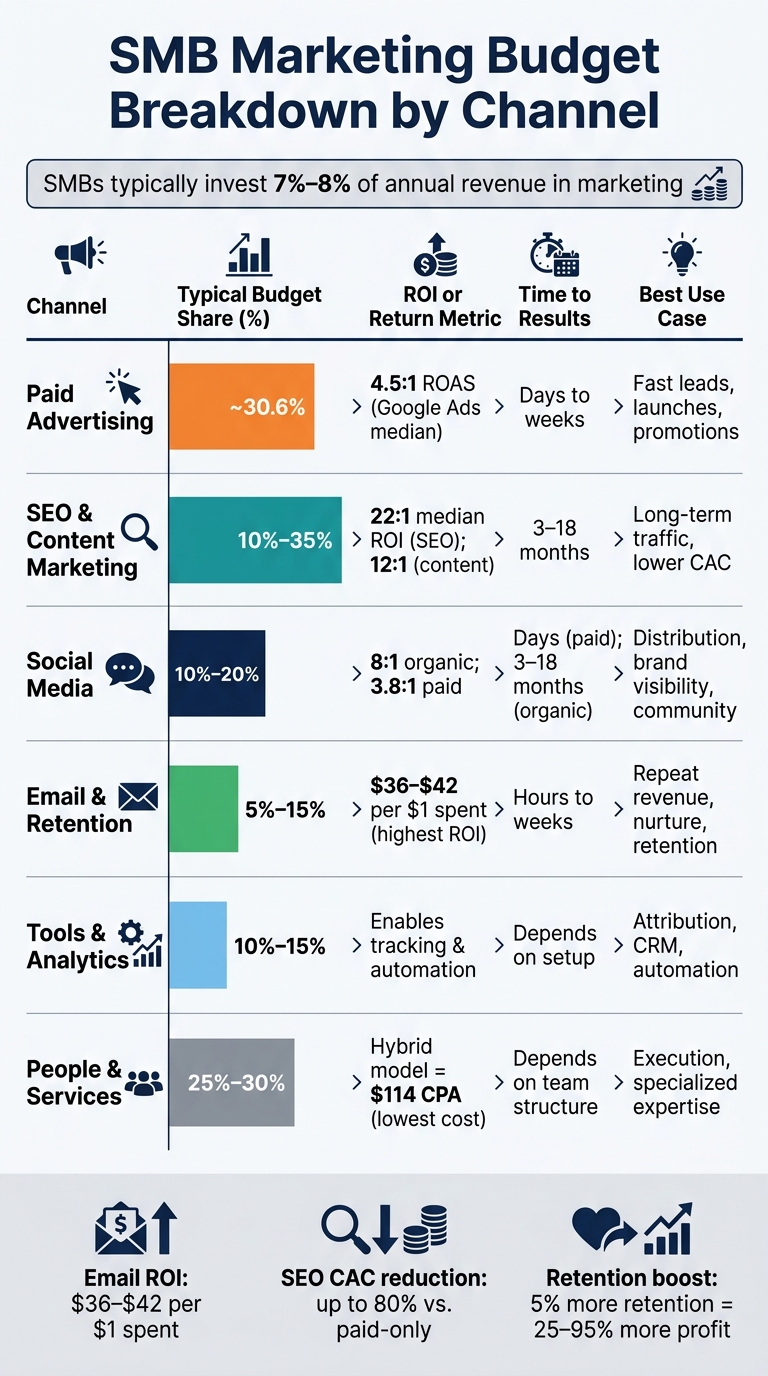
SMB Marketing Budget Breakdown by Channel: Allocations, ROI & Timelines
| Budget Area | What it does best | Usual Budget Share | Time to See Results |
|---|---|---|---|
| Paid Ads | Leads and traffic now | 30.6% | Days to weeks |
| SEO & Content | Search traffic and lower CAC over time | 10%–35% | 3–18 months |
| Social Media | Distribution, visibility, community | 10%–20% | Days for paid, months for organic |
| Repeat sales and nurture | 5%–15% | Hours to weeks | |
| Tools & Analytics | Tracking and automation | 10%–15% | Depends on setup |
| People & Services | Execution and channel support | 25%–30% of spend in many SMB setups | Depends on team structure |
If I had to sum it up in one line: don’t spread a small budget too thin – pick one or two channels, track results, and shift money toward what pays back.
Paid advertising often eats up the biggest slice of an SMB marketing budget. In 2026, it averages 30.6% of total spend.
The big mistake is simple: scaling spend before the basics are in place. Before you put more money into ads, make sure your site loads fast, works well on mobile, and tracks conversions the right way. Set up Google Analytics and UTM tracking before launch. Without that setup, you’re flying blind.
Budget size matters, but channel choice matters just as much. Paid search through Google Ads has a median return on ad spend of 4.5:1, while paid social on Meta and LinkedIn lands at 3.8:1. For local service businesses like plumbers, HVAC companies, and contractors, Google Local Service Ads are often a strong match. They can start bringing in leads fast and usually need less minimum spend than standard search campaigns. In practice, B2C SMBs tend to lean into social ads, while B2B SMBs usually put more weight on paid search and LinkedIn.
One of the most common budget problems is spreading a small spend across too many places. That sounds smart on paper, but it often weakens results. When budgets are tight, focus beats reach. If ad spend is under $2,000 per month, it’s usually better to own one or two channels instead of splitting funds across five or more. For Google Ads, $1,500–$3,000 per month is often the floor if you want enough data to tune campaigns well.
There also needs to be a clear financial target. Aim for a 3:1 LTV:CAC ratio – every $1 spent to win a customer should bring back at least $3 in lifetime value. If a channel stays below 2:1 ROAS after a full quarter, that’s usually a sign to fix the campaign setup or move that money somewhere else. Paid ads give you speed. SEO and content help bring acquisition costs down over time.
SEO and content marketing can build long-term traffic and bring down acquisition costs. That’s why many SMBs put roughly 10% to 35% of their marketing budget into this area. The payoff can be strong: SEO has a median ROI of 22:1, while content marketing averages 12:1.
The catch is speed. SEO often takes 3 to 6 months to show traction, and content can need 6 to 18 months before it hits its high point. Because of that, paid search works well during the ramp-up. It keeps leads coming in while your organic assets start to do their job. Then, once organic traffic starts to build, social and community channels can help push that content farther and get it in front of more people faster.
Over time, SEO often cuts acquisition costs. Companies that stick with it may see CAC drop by 50% to 80% compared with relying on paid channels alone.
AI-assisted workflows can also change the math. Monthly content writing costs can drop from $3,000–$5,000 to around $800–$1,200. Budget patterns also differ by business type:
One problem shows up again and again: content with no distribution plan. A blog post, guide, or landing page needs a clear route to an audience through organic search, email, or social. If there’s no path, even good content can just sit there.
A quarterly review helps keep this channel honest. Look at which pieces are driving leads, not just pageviews, and treat the SEO budget like a dial you can turn up or down instead of a fixed line item. Good content also gives email and retention campaigns more to work with, which can help convert and re-engage existing audiences.
Social media helps your content travel farther. More than that, it helps turn borrowed attention into an audience you can reach on your own terms.
For U.S. SMBs, social media and community building usually take 10% to 20% of the total marketing budget. That share changes by business type. B2C brands often come in closer to 22%, while B2B companies tend to stay near 14% and put a lot of that effort into LinkedIn for relationship-building.
Paid and organic social do different jobs, and it helps to treat them that way. Paid social can bring in traffic within days. Organic social takes more patience. Most businesses should expect at least 3 months before seeing meaningful leads, and 6 to 18 months before performance hits its high point.
That slower ramp can still pay off. Organic social tends to build momentum over time, with a median ROI of 8:1, compared with 3.8:1 for paid social. So social isn’t just an engagement play. It’s also a distribution channel.
If your budget is tight, put money and effort into the platform where your audience already spends time. Chasing every channel is a fast way to burn cash. And there’s another problem: when you build on a platform you don’t own, traffic can vanish the moment the algorithm changes or your ad spend stops.
That’s why social should push people into channels you control, such as:
That way, the relationship doesn’t disappear with the next platform shake-up.
A smart starting point is 1–2 channels. Get those working first, then branch out. Use UTM and CRM data to track pipeline impact instead of vanity metrics like likes or reach. When social is focused and measured well, it can help with retention just as much as acquisition.
Use these ranges as a starting point, then tighten them based on where your audience is most concentrated:
| Business Type | Recommended Allocation | Primary Focus |
|---|---|---|
| Visual/Lifestyle Brand | 15–30% | Short-form video, influencers |
| B2B Service Business | 5–15% | LinkedIn, thought leadership |
| Founder-Led Brand | 10–20% | Personal branding, community |
| Local Service Business | 5–10% | Local awareness, reviews |
Social and search can bring people in. Email keeps them around.
That matters for SMBs because email turns traffic you already earned – and customers you already paid to get – into repeat revenue. Instead of spending more money to chase new demand, you can convert demand that’s already there. That helps protect margin, and the payoff can be huge: email often delivers the highest ROI of any channel, at $36 to $42 for every $1 spent.
Most U.S. SMBs put about 5% to 15% of their marketing budget into email. Businesses that care a lot about retention and nurture may push that number to 25%.
Another reason email works so well: it’s fast.
You can launch campaigns without a long setup cycle, and results can start showing up within hours or weeks. That makes email useful when you need to close a short-term revenue gap. It also works well for longer nurture flows that guide people from first interest to purchase.
Retention is just as important as acquisition, and the numbers make that pretty clear. The odds of selling to an existing customer are 60% to 70%, while the odds of selling to a new prospect are only 5% to 20%. On top of that, increasing customer retention by just 5% can lift profits by 25% to 95%.
Even with that, plenty of SMBs still put too much money into acquisition and too little into the people already on their list or already buying from them.
The weak spots are usually pretty simple:
Segmentation, in particular, can make a big difference. Segmented campaigns tend to beat generic sends, with average open rates around 46% versus roughly 21% to 33% for non-segmented campaigns.
Because email performance depends so much on clean data, segmentation, and automation, the next budget line is tools and analytics.
Marketing results live or die on clean data. And clean data starts with the right setup.
U.S. SMBs usually put 10% to 15% of their marketing budget into tools, analytics, and marketing tech. That includes CRMs, analytics platforms, automation software, and AI tools. For a small or midsize business, this is the layer that turns marketing spend into something you can actually track.
AI use is climbing fast. 61% of SMBs are increasing spend on AI-assisted content and automation tools in 2026. On top of that, these tools can cut production costs by 60% to 80%. In plain English: some of the budget that used to go to freelancers or agencies now shifts into software instead.
That said, lower production costs don’t mean less work. Someone still has to set the tools up, check the data, and make sure nothing slips through the cracks. That’s where things can get messy. 38% of SMBs find marketing tools too complex to manage effectively, and many waste between $200 and $800 per month on duplicate or unused subscriptions. It’s a bit like paying for five streaming services and only watching one. An annual tool audit can help spot overlap and cut software that no longer earns its keep.
The biggest problem is attribution. Only 38% of SMBs use a clear attribution model. Without that, it’s hard to compare channels with any confidence or know where to move budget next. A simple starting point works well for most teams:
A basic stack like this usually costs $300 to $600 per month.
Even the best setup falls flat if nobody owns the data, reporting, and follow-up.
The last big budget bucket is execution: who’s doing the work?
For U.S. SMBs spending more than $5,000 per month, about 30% of the marketing budget goes to salaries or agency fees. For companies spending $2,000 to $5,000 per month, that share is closer to 25%. That split also changes based on growth stage and business type.
A lot of SMBs use a hybrid setup. They keep strategy in-house and outsource channel work like paid search or SEO. And there’s a cost angle here too. That setup comes in at $114 CPA, compared with $127 for fully outsourced teams and $148 for fully in-house teams.
The work SMBs outsource most often includes:
Agencies can give you access to people with skill in many channels. But there’s a trade-off: you give up some control in exchange for that range.
In practice, the in-house vs. agency decision often comes down to budget. For businesses under $5 million in annual revenue, a senior in-house marketer can cost $120,000 to $180,000 per year all-in. A typical agency retainer is $2,000 to $10,000 per month. For many small businesses, that means access to channel specialists for less than the cost of one senior full-time hire.
Still, outsourcing isn’t a free lunch. Agencies often manage 20 to 50 accounts at the same time, which can mean less attention for a small business. There’s also the issue of incentives. Percentage-of-spend pricing can reward spending more, not getting better results. That’s why a 90-day pilot makes sense. It gives you room to test the fit before you go all in. And no matter who you hire, keep ownership of your ad accounts, domains, and content.
For SMBs in the $1 million to $5 million revenue range that aren’t ready for a full-time marketing director, a fractional CMO can fill the gap. Pricing usually lands between $4,000 and $10,000 per month. You get senior-level strategy without taking on the fixed cost of a full-time leader.
The lowest-cost setup usually keeps brand guidelines and customer data in-house while outsourcing the technical execution. As the business grows, those staffing choices tend to shift with it.
Your budget split changes based on two things: where the business is in its growth and how the business makes money.
The channel benchmarks above give you a starting point. From there, growth stage and business model shape the final mix. On $1 million in annual revenue, a common split looks like this:
| Growth Stage | Annual Budget on $1M Revenue | Primary Focus |
|---|---|---|
| Early/Launch | $150,000–$200,000 | Brand foundation, aggressive PPC |
| Growth/Established | $80,000–$120,000 | Multi-channel scaling, SEO, email, and automation |
| Mature/Maintenance | $40,000–$70,000 | Retention, referral, efficiency |
Early-stage SMBs often put 15%–20% of revenue into marketing. Growth-stage businesses usually spend 8%–12%. Mature businesses tend to land at 4%–7%.
That shift makes sense. A new company often needs leads now, so paid acquisition does more of the heavy lifting. As the business grows, more of the budget moves toward SEO, email, and automation. Mature businesses lean harder on brand equity, referrals, and retention to keep acquisition costs in check. Put simply: stage affects how long you can afford to wait for payback.
Business type pushes the mix even further. Local service companies often lean more on paid channels. B2B companies usually spend more on content and tools. E-commerce brands tend to put more into social and email. Here’s how those channel splits often look:
| Business Type | Paid Search/Ads | SEO & Content | Social Media | Email/Retention | Tools/Analytics |
|---|---|---|---|---|---|
| Local Service (e.g., HVAC) | 35%–50% | 20%–25% | 10%–15% | 5%–10% | 5%–10% |
| B2B (e.g., SaaS/Services) | 15%–20% | 25%–35% | 10%–15% | 10%–15% | 20%–28% |
| E-commerce (Direct-to-Consumer) | 20%–25% | 10%–15% | 25%–30% | 15%–20% | 5%–10% |
A local HVAC company, for example, may need Google Ads to keep the phone ringing. A SaaS company can wait longer if content, CRM tools, and lead nurturing bring down CAC over time. An e-commerce brand often lives or dies by paid social, repeat purchases, and email flows.
The next step is judging each category by speed, durability, and control.
Every budget category comes with a tradeoff between speed, cost, and control. The table below makes those tradeoffs easier to see, so you can put money where it fits your goals.
| Budget Category | Main Advantages | Main Disadvantages | Best Use Case |
|---|---|---|---|
| Paid Advertising | Instant traffic; precise targeting | Stops immediately when budget ends; high ongoing costs | Launches, promos, and fast lead generation |
| SEO & Content | Compounding ROI; lowers CAC over time | Slow results (3 to 6 months); requires consistent effort | Businesses that can wait for compounding returns |
| Email & Retention | Owned audience; highest ROI | Requires an existing list; risk of unsubscribes without quality content | Brands with repeat buyers or a warm list |
| Social Media | Builds trust and community | Low organic reach without paid boost; platform algorithm dependency | Brands that need trust, visibility, and community |
| Marketing Tech | Enables automation; improves tracking | Risk of tool bloat; high learning curve | Teams that need better tracking and automation |
| People and Services | Access to specialized expertise; saves owner time | Higher upfront cost than DIY; requires active relationship management | Teams that need specialized execution without full-time hires |
Here’s the short version: paid ads and social are rented channels. When spending stops, traffic usually stops too.
That doesn’t make them bad. It just means they work best when you need speed, tight targeting, or a fast push around a launch or promo. By contrast, channels like SEO, content, and email can keep paying off after the first spend, but they take more time and steady work.
Once you can see the tradeoffs this clearly, picking the right mix gets a lot easier. It comes down to your stage, your sales cycle, and how long you can wait for results.
After weighing the tradeoffs, the best budget is the one that fits your growth stage and sales cycle. A solid starting point is 7%–8% of gross revenue, with younger businesses often spending more to build demand.
The main tradeoff is simple: paid ads can drive demand now, while SEO, content, and email can bring down CAC over time. So the next step is clear: decide how much of your budget should go toward immediate demand, and how much should go toward assets that can pay off month after month.
Keep it simple at first. Start with one or two channels, and put enough money behind them to get useful data. Track every channel, cut what isn’t paying back, and keep backing the ones that build over time. Blue Aspen Marketing can help put together a stage-based budget mix.
Choose your marketing mix based on your growth stage, business model, and goals, not by splitting your budget evenly. Start with the basics first: branding and a high-quality website. If that foundation is weak, adding more traffic usually just means wasting money at a larger scale.
Put most of your effort into the 2–3 channels where your audience spends time. That’s usually the sweet spot.
For many B2B companies, that means:
For many B2C brands, stronger returns often come from:
Check performance on a regular basis, then shift spend and effort toward the channels that bring in the most revenue.
With a small budget, start with channels that are easy to use, easy to track, and built to pay off over time.
Email marketing is one of the best places to begin. It doesn’t cost much, can drive a high ROI, and gives you direct access to your audience data. That matters. You’re not renting attention from another platform – you have your own list.
If you need results sooner and want clear numbers, paid search is a smart next step. It puts your business in front of people who are already looking for your services, and you can control spend closely while tracking what each dollar brings back.
Shift budget from paid ads to SEO or email when your priority moves from short-term acquisition to long-term returns.
Paid ads can bring in inquiries fast, and you can track them with little guesswork. SEO works differently. It builds search visibility over time, and that can bring down acquisition costs as that visibility stacks up.
Email marketing plays a different role, but an important one. It’s often a low-cost way to nurture existing leads, stay in touch, and depend less on algorithm shifts or climbing ad costs.


 Physical Therapy
 MedSpa
 Dental
 HVAC
HVAC Roofing
 Pest Control
 Cleaning Services
 Landscaping
 Hotel
Hotel Cruise
 Branding
 Content Marketing
 Email Marketing
 Graphic Design
 PPC (Online Ads)
 SEO (Search Engine Optimization)
 Website Design and Development
 Pest Control
 Plastic Surgeon
 Roofing