When deciding between Google Local Search Ads (LSAs) and Facebook Ads to generate roofing leads, the right choice depends on your goals and budget. Here’s what you need to know:
| Feature | Google Local Search Ads | Facebook Ads |
|---|---|---|
| Lead Intent | High (active search) | Moderate (passive browsing) |
| Cost Per Lead | $50–$180 | $22–$30 |
| Conversion Rate | 7.33% | 9.21% |
| Best For | Urgent repairs, high-intent leads | Awareness, long-term lead nurturing |
| Payment Model | Pay-per-lead | Pay-per-click/impression |
If you’re looking for immediate results, Google LSAs are the way to go. For long-term growth and brand visibility, Facebook Ads are better suited. The best strategy? Combine both platforms to balance short-term gains with long-term awareness.
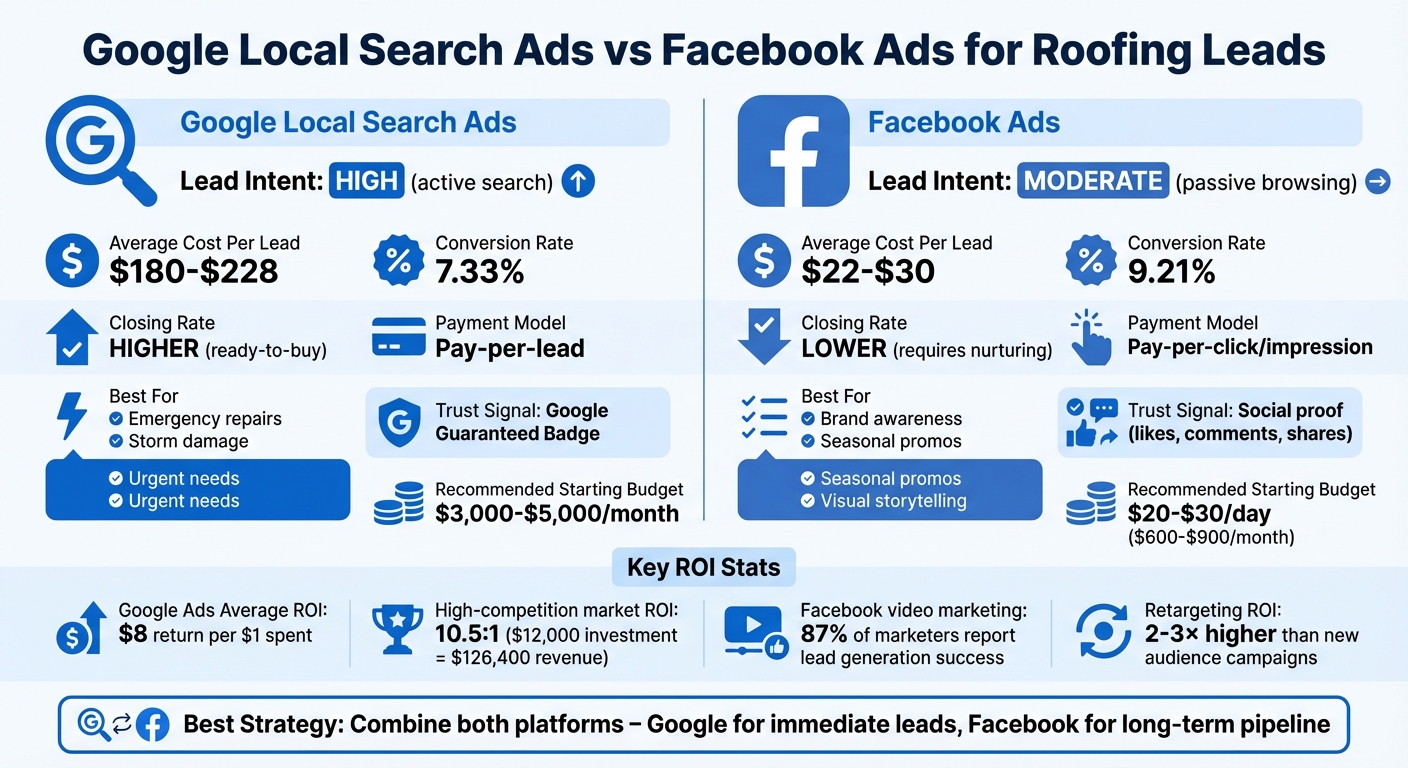
Google Local Search Ads vs Facebook Ads for Roofing: Cost and Performance Comparison
Google Local Search Ads (LSAs) sit right at the top of search results – above even traditional pay-per-click ads. If a homeowner searches for something like "roof replacement near me" or "emergency roof repair", your business can show up with a Google Verified badge, contact details, operating hours, and customer reviews . This is a prime spot, especially since nearly half (46%) of all Google searches have local intent.
What makes LSAs even more appealing is their pay-per-lead model. You’re only charged when someone directly contacts your business through a call or message. This setup not only saves costs but also increases the chances of converting leads, particularly in urgent situations like roofing emergencies where trust is crucial. With these features, LSAs don’t just improve visibility – they also help businesses connect with the right audience at the right time.
LSAs are designed to reach homeowners exactly when they’re actively searching for roofing services. Alex Mallin, PPC Specialist at Improve & Grow, puts it this way:
"What makes Google Ads particularly powerful for roofers is that you’re capturing homeowners at the exact moment they’re actively searching for your services."
The platform offers precise targeting options. You can tailor your service area by zip codes, cities, or even entire counties. Plus, you can specify the types of jobs you want your ads to appear for – whether it’s roof repairs, full replacements, storm damage restoration, or gutter installations. Google also factors in proximity, prioritizing your ad for homeowners near your business.
Speed matters, too. Responding within 5 minutes instead of 30 can double your conversion rates. Quick replies not only improve conversions but also help maintain a strong ad ranking. By narrowing down your service areas and job types, LSAs deliver high-quality leads, which directly impacts your return on investment (ROI).
The cost of LSAs depends on the type of job and local competition. For example, storm damage leads through LSAs average around $180, while roof replacement leads from traditional search ads cost closer to $280. General roofing and gutter leads are typically priced at about $101.49. In smaller markets, search ads might cost $10 per click, but in competitive areas like Dallas or Phoenix, that rate can climb above $15 per click.
The ROI potential is impressive. On average, businesses see an $8 return for every $1 spent on Google Ads. In highly competitive markets, ROI can climb to 10.5:1, meaning a $12,000 monthly investment could generate $126,400 in revenue. Conversion rates for home improvement advertisers typically range from 2.70% to 9.99%, with well-optimized campaigns hitting the higher end of that spectrum. These results tie directly to lead quality and how quickly businesses respond to inquiries.
For roofing companies, a starting budget of $3,000–$5,000 per month is recommended to achieve consistent results. In high-competition areas, scaling may require a budget of at least $12,000 per month. During storm seasons, many contractors increase their budgets by 150–200% to handle the surge in demand for emergency repairs. Setting up a professional campaign usually costs between $1,000 and $1,500, with ongoing management fees falling in the same range.
Facebook Ads show up in users’ feeds, Stories, and even Messenger, catching their attention even when they’re not actively searching for services. This "interruption marketing" strategy is perfect for building brand awareness and reaching homeowners who might need roofing services down the line, even before they start looking for help .
One of Facebook’s standout features is its Lead Generation ad format, which allows users to share their contact details directly within Facebook. This seamless process increases conversion rates by around 25% compared to ads that direct users to external websites. Roofers can also leverage engaging content formats to connect with potential customers. For example, before-and-after photos of roofing projects highlight expertise and build trust . Meanwhile, videos featuring the business owner or crew add a personal touch, fostering stronger connections. In fact, 87% of marketers using video report that it has directly helped them generate leads. By combining these formats, roofers can not only boost brand awareness but also create highly targeted campaigns to reach the right audience.
Facebook’s advanced targeting tools make it easy for roofers to focus on their ideal customer base. You can define a specific radius – say, 25–30 miles around your business – or target particular ZIP codes and neighborhoods. You can even refine your audience by filtering for homeownership, age, income, and interests like home improvement or DIY projects. The platform’s demographic data reveals that key homeowner groups include users aged 25–34 (25% of Facebook users) and 35–44 (18% of users), making them prime targets for roofing services.
Life events, like moving to a new home, are another useful targeting option, as these homeowners often need roof inspections or repairs. Retargeting is another powerful tool. By adding the Meta Pixel to your website, you can re-engage visitors who didn’t convert on their first visit. Retargeting campaigns typically deliver a 2–3× higher ROI compared to efforts aimed at brand-new audiences. Timing also plays a role – launching ads after severe weather events, like storms, can increase engagement by about 50%. With these targeting strategies in place, the next step is understanding how costs and returns shape your campaign’s success.
On average, roofing leads through Facebook cost $30 each, with a click costing about $2.50. These rates make Facebook a more affordable option compared to Google Search Ads, where leads typically range from $50 to $75 . Additionally, the cost per thousand impressions on Facebook averages around $11.49 .
However, the lower cost comes with a trade-off: Facebook leads often require more follow-up to convert them into paying customers. This is because homeowners are usually browsing social media casually rather than actively looking for roofing services .
Matt Janaway, founder of MarketingLabs, highlights the importance of follow-up:
"A surefire way to generate a consistent lead magnet is to accept that giving just a small amount of your time or experience away will lead to greater rewards. This time could be in the form of a free quick consultation chat or a detailed quote."
For those starting out, a budget of $20–$30 per day is sufficient for testing campaigns. However, increasing to $50 per day allows Facebook’s algorithm to gather more data and optimize your ads for better results . Carousel ads are another cost-effective option, often delivering 30–50% lower cost-per-conversion compared to single-image ads. Plus, mobile-optimized visuals can boost click-through rates by about 40%. By balancing budget, creativity, and strategy, roofing businesses can make the most of Facebook Ads.
Google Local Search Ads are perfect for moments when homeowners need urgent help. Think about a scenario where a storm has just passed, and someone’s roof is leaking – they’re typing "emergency roof repair near me" into Google. These are high-intent searches, meaning the homeowner already knows they need a roofer. They’re just deciding who to call.
Storm season is when Google LSAs shine. After severe weather hits, searches for roofing contractors spike as homeowners scramble for quick fixes. The Google Guaranteed badge plays a big role here, offering a layer of trust and credibility that makes your business stand out. Plus, the pay-per-lead model is more efficient because you can dispute charges for irrelevant leads, like those outside your service area or for services you don’t provide.
Ryan R Goering, Founder of BaaDigi, puts it well:
"Google Ads excel at capturing high-intent searches when people need immediate solutions… Facebook Ads interrupt people during their downtime, needing to stop them mid-scroll."
This distinction is key when deciding between immediate and long-term advertising strategies.
Facebook Ads, on the other hand, are ideal for building awareness and staying on homeowners’ radar in non-emergency situations. When someone isn’t actively searching for a roofer, Facebook allows you to showcase your expertise through before-and-after photos, drone videos, and customer testimonials. This kind of visual storytelling builds trust and keeps your business top-of-mind for when they eventually need repairs.
Seasonal promotions like "Spring Roof Inspection" or "Free Storm Damage Assessment" work particularly well on Facebook. You can also get creative with targeting – focus on neighborhoods recently hit by storms or homeowners flagged as "recently moved." With lower lead costs compared to Google, Facebook is a cost-effective way to fill your pipeline with potential future customers.
However, keep in mind that Facebook leads often require more nurturing. These homeowners are casually browsing rather than urgently looking for a solution. This means follow-up is crucial to turn these leads into paying customers.
Here’s a quick breakdown of how the two platforms stack up:
| Feature | Google Local Search Ads | Facebook Ads |
|---|---|---|
| Lead Intent | High – active search | Moderate – passive browsing |
| Avg. Cost Per Lead | $180–$228 | $22–$30 |
| Conversion Rate | 7.33% | 9.21% |
| Closing Rate | Higher (Ready-to-buy) | Lower (Requires nurturing) |
| Payment Model | Pay-per-lead | Pay-per-click/impression |
| Primary Strength | Emergency repairs, immediate needs | Brand awareness, visual storytelling |
| Trust Signal | Google Guaranteed Badge | Social proof (likes, comments, shares) |
| Best Use Cases | Storm damage, leaks, urgent repairs | Seasonal promos, neighborhood targeting, retargeting |
This side-by-side comparison highlights the strengths of each platform. While Facebook boasts a slightly higher conversion rate (9.21% vs. Google’s 7.33%), the nature of those conversions differs. Facebook leads are often early in their decision-making process, like filling out a form out of curiosity. Google leads, on the other hand, are more likely to result in booked appointments because the homeowner is ready to hire.
For example, one roofing contractor reported a 4,700% ROI on Facebook compared to 1,900% on Google. However, Google had a much higher closing rate of 25% versus Facebook’s 8%. These differences can guide roofing businesses in choosing the platform that aligns with their immediate or long-term goals.
When deciding how to allocate your advertising budget, it’s essential to match your ad strategy to your services and capacity. For emergency repairs, Google Local Search Ads are a strong choice because they connect you with customers who need immediate help. On the other hand, if you’re focusing on full roof replacements or upgrades, Facebook Ads can showcase your craftsmanship through visuals, making it a great platform for building interest and trust. Your service type and how quickly you can follow up on leads should guide your spending decisions.
Sales capacity is another key factor. Leads from Facebook often require more nurturing, as they are sometimes considered less ready to buy. If your team isn’t equipped to follow up quickly, these leads may not convert as easily. In contrast, leads from Google typically show higher intent to purchase and demand less effort to close.
Local competition also affects your strategy. In crowded metro markets, Google’s cost-per-click can be high – storm damage leads, for instance, can cost as much as $450 each. If your budget is tight, Google Local Services Ads are a smart starting point. Their pay-per-lead model and the credibility of the Google Guaranteed badge make them a cost-effective option. As your revenue increases, you can expand your approach by incorporating Facebook Ads.
A common guideline is to allocate 10%–15% of your annual revenue to advertising. In competitive markets, a monthly budget of $12,000 might look something like this: 65% for Google Search Ads, 30% for Google Local Services Ads, and 5% for social media. During storm season, many contractors increase their ad spend by 150%–200% to take advantage of the surge in demand.
Blue Aspen Marketing simplifies ad management by focusing on strategies that maximize your return on investment. They use tools like keyword optimization, hyper-local targeting, and retargeting to ensure your budget is spent effectively. With expertise in PPC, SEO, and content marketing, Blue Aspen Marketing analyzes performance data to allocate about 70% of your budget to the most effective ad sets. This tailored approach helps roofing businesses get the most out of their advertising efforts.
The best results come from using Google and Facebook together, rather than relying on just one platform. Google is ideal for reaching homeowners who are ready to hire right away, while Facebook builds awareness and fills your pipeline with potential future customers. These platforms work well together – Facebook ads can influence people to search for your business on Google later.
If you’re working with a smaller budget, start with Google Local Services Ads. Their pay-per-lead model and the Google Guaranteed badge provide instant credibility. As your business grows, add Facebook Ads to target neighborhoods hit by storms, promote seasonal deals, and retarget visitors who’ve already been to your website. To maximize conversions, aim to respond to new leads within five minutes.
Google Local Search Ads (LSAs) are a powerful way to connect with potential roofing customers who are actively searching for services like “roof repair near me” or “roof replacement in [city].” These ads show up prominently at the top of Google search results and include the Google Guaranteed badge, which helps establish credibility. LSAs are all about targeting location-specific, high-intent searches, focusing on users within your service area who are ready to hire.
Facebook Ads take a different approach. Instead of targeting search intent, they allow you to reach potential customers based on demographics, interests, and behaviors. You can refine your audience by factors like location, age, homeownership status, and interests such as home improvement. This strategy helps you connect with homeowners before they’re actively searching for roofing services, making it an excellent tool for building awareness. Plus, you can use engaging visuals – like before-and-after photos of roofing projects – to capture attention.
In short, LSAs are ideal for capturing ready-to-act leads, while Facebook Ads shine when it comes to building awareness and reaching homeowners earlier in their decision process.
Google Local Service Ads (LSAs) work on a pay-per-lead model, meaning you only pay when a potential customer contacts you directly through the ad. This approach ensures your budget is tied to actual leads, but the cost per lead can be higher – especially in competitive fields like roofing. In contrast, Facebook Ads typically charge based on impressions (CPM) or clicks (CPC), enabling you to reach a much wider audience at a lower upfront cost. The downside? You might end up paying for clicks or views from users who aren’t genuinely interested in your services, which can drive up the cost of acquiring qualified leads.
Roofing businesses often allocate $500–$1,000 per month for Facebook campaigns, covering both ad spend and creative content. LSAs, on the other hand, focus on high-intent leads, which can justify their higher cost per lead by avoiding wasted clicks. While LSAs excel at capturing customers actively searching for services, Facebook Ads can help you reach a broader audience at a lower cost – if managed effectively.
For urgent roofing repairs, Google Local Service Ads can be a game-changer. These ads are designed to reach homeowners who are specifically searching for services like "emergency roof repair" and connect them with local businesses almost instantly. This makes them a powerful tool for capturing high-intent leads – people who are not just browsing but are ready to act.
In contrast, Facebook Ads shine when it comes to building brand awareness or engaging broader audiences over time. While they can be effective in their own way, they don’t quite match the immediacy or intent-driven focus that Google Ads offer for emergency services.


 Physical Therapy
 MedSpa
 Dental
 HVAC
HVAC Roofing
 Pest Control
 Cleaning Services
 Landscaping
 Hotel
Hotel Cruise
 Branding
 Content Marketing
 Email Marketing
 Graphic Design
 PPC (Online Ads)
 SEO (Search Engine Optimization)
 Website Design and Development
 Pest Control
 Plastic Surgeon
 Roofing